How to Start an Online Fitness Store (Apparel, Supplements, Gear)
How to Start an Online Fitness Store (Apparel, Supplements, Gear)
People who train are loyal customers. They wear out leggings, run out of protein and keep adding to their home gym. That makes fitness a good category for a small online shop, as long as you choose your lane carefully. This guide explains how to start an online fitness store, from picking between activewear, supplements and equipment to sizing, labelling, shipping heavy gear and building the community that keeps people coming back.
Pick Your Lane: Activewear, Supplements or Equipment
The three main fitness categories behave like three different businesses. Many stores sell all three eventually, but it pays to lead with one.
| Activewear | Supplements | Equipment | |
|---|---|---|---|
| Variants | Sizes and colours, often many per product | Flavours and pack sizes | Weights, lengths, sometimes colours |
| Shipping | Light and easy | Light to medium, some heavy tubs | Heavy, bulky and expensive |
| Rules to check | Fibre content and care labelling | Ingredients, claims, labelling, sometimes registration | Product safety and warranty terms |
| Returns | Frequent, mostly for fit | Usually limited once opened | Costly to ship back |
| Repeat buying | New colours and seasons | Monthly reorders | Lower, but bigger orders |
If you want low shipping costs and strong branding, start with activewear. If you want repeat orders, supplements are the obvious choice, but expect more rules. Equipment brings big orders and big logistics problems.
Serve a Community, Not Just a Category
"Fitness" is too broad. Pick a group of people who train in a particular way and know what they need:
- home gym builders with limited space
- runners and run clubs
- yoga and pilates practitioners
- strength training for beginners or older adults
- women's lifting
- martial arts and combat sports
- outdoor and functional training
A focused store can write better product descriptions, pick better products and get recommended in that community's groups and forums. You can always widen the range later.
Sourcing Your Products
Activewear. Work with a private-label manufacturer or a small factory. Order samples in every size and wash and wear them for a few weeks: check stretch, see-through in squats, seams and how colours hold up. Inconsistent sizing between batches is the fastest way to get returns.
Supplements. Use an established contract manufacturer that can provide documentation for each batch, such as ingredient specifications and test results. Ask about minimum order quantities, shelf life and lead times before you design a label.
Equipment. Most small stores buy from wholesalers or distributors, or use a supplier that ships direct. Check weights and dimensions, warranty terms, spare parts and how the supplier handles damaged deliveries.
Whatever you sell, keep supplier invoices and batch records. You'll need them if a customer complains or a product has to be recalled.
Sizes, Flavours and Colours
Product options matter more in fitness than in most categories, because a wrong size or flavour means a return or a bad review.
- One product, many variants. A training top in five sizes and three colours is one product with 15 variants, each with its own stock count.
- A real size chart. Use body measurements in centimetres and inches, not just S/M/L. Add fit notes such as "compressive", "relaxed" or "size up if between sizes".
- Model details. "Model is 175 cm and wears M" helps shoppers more than any chart.
- Flavours and pack sizes. Show each flavour as an option with its own photo and stock, and show price per serving next to each pack size.
- Colour photos. Every colour needs its own photos. Shoppers don't trust a colour swatch alone.
Supplement Labelling and Claims: Check the Local Rules
Supplements are regulated in most places, and the rules differ widely between markets. Before you sell, check the rules where you sell for:
- what the label must show: ingredients, amounts per serving, allergens, directions and warnings
- which health or performance claims are allowed, if any
- whether you must register or notify products before selling
- batch numbers and best-before dates
- ingredients that are restricted, or banned in tested sports
Keep product copy factual: what's in it, how to use it, what it tastes like. Avoid promises about results, weight loss or curing anything. If you're unsure, ask a regulatory adviser before you print labels, not after.
Shipping Heavy and Bulky Equipment
Equipment is where many fitness stores lose money without noticing. A rack or a set of plates can cost more to ship than the profit on the sale.
- Know your dimensional weight. Carriers often charge by box size as well as weight. Measure every packed item.
- Use shipping zones or freight quotes for big items instead of one flat rate that loses money on distant orders.
- Offer local pickup or delivery for heavy gear if you have a local customer base.
- Pack for impact. Plates and dumbbells break boxes. Use strong cartons, corner protection and strapping.
- Include assembly instructions and list every part, so missing bolts don't turn into returns.
- Price returns honestly. Decide who pays return shipping on heavy items and state it clearly, after checking consumer rules where you sell.
For a deeper comparison of flat rates, live rates and fulfilment partners, read Shipping for eCommerce MVPs.
Bundles and Starter Kits
Bundles raise order value and solve the beginner's question, "what do I actually need?"
- Home gym starter: adjustable dumbbells, a mat and resistance bands.
- Yoga starter: mat, blocks, strap and a towel.
- Training day kit: shaker, water bottle and gym bag.
- Activewear sets: a matching top and bottoms at a small discount.
- Supplement packs: two or three products that are often bought together. Describe what's in them, not what results they'll bring.
A free-shipping threshold works well alongside bundles: shoppers add a band or a shaker to get over the line.
Pricing and Returns
Price each lane differently. Activewear needs room for returns and markdowns at the end of a season. Supplements need room for subscriptions or reorder discounts. Equipment prices must include real shipping costs, or set shipping separately.
Write a returns policy for each lane: easy exchanges for clothing sizes, a clear position on opened supplements, and rules for heavy items. Check consumer rules where you sell, and keep the policy short and easy to find.
Marketing: Content and Community
Fitness shoppers trust people who train, so your marketing should look like training, not advertising.
- Useful content. Beginner workout plans, "how to choose a yoga mat", "home gym on a small budget". Link each guide to the products it mentions. Guides like these can rank in search for years.
- Fit reviews. Ask reviewers for their height, usual size and how the item fits. Show it on the product page.
- Local partners. Gyms, run clubs and yoga studios can stock a few items, run a challenge with you or share a discount code.
- Small creators. Coaches and athletes with engaged followings in your niche often sell more than big accounts.
- Challenges. A 30-day training challenge with a simple plan, a hashtag and a prize gives people a reason to post about you.
- Reorder emails. Remind supplement buyers before their tub runs out.
Launch Faster With the Fitness Store
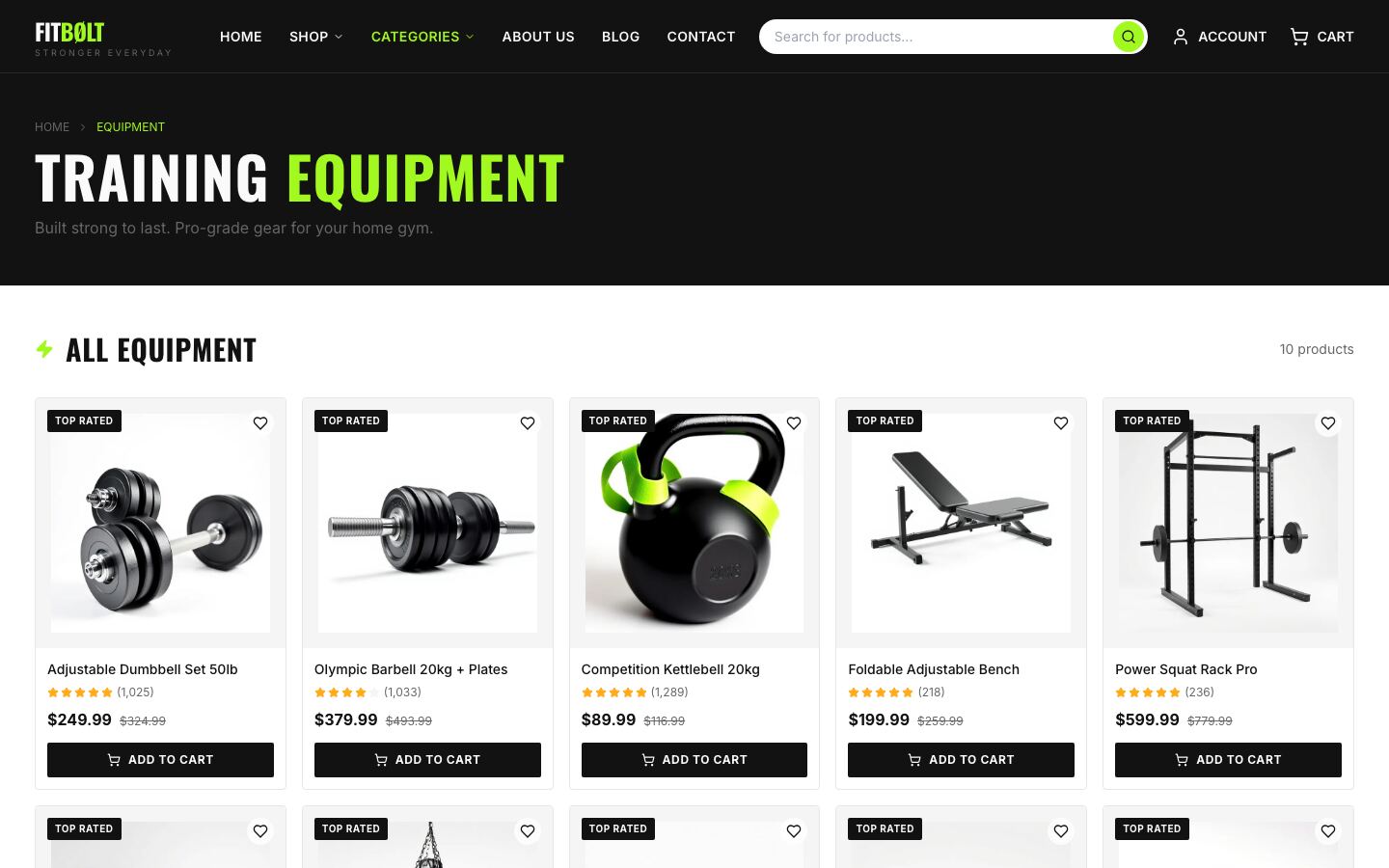
We built the Fitness Store for shops that sell training gear, so you can launch with a bold storefront instead of starting from an empty project.
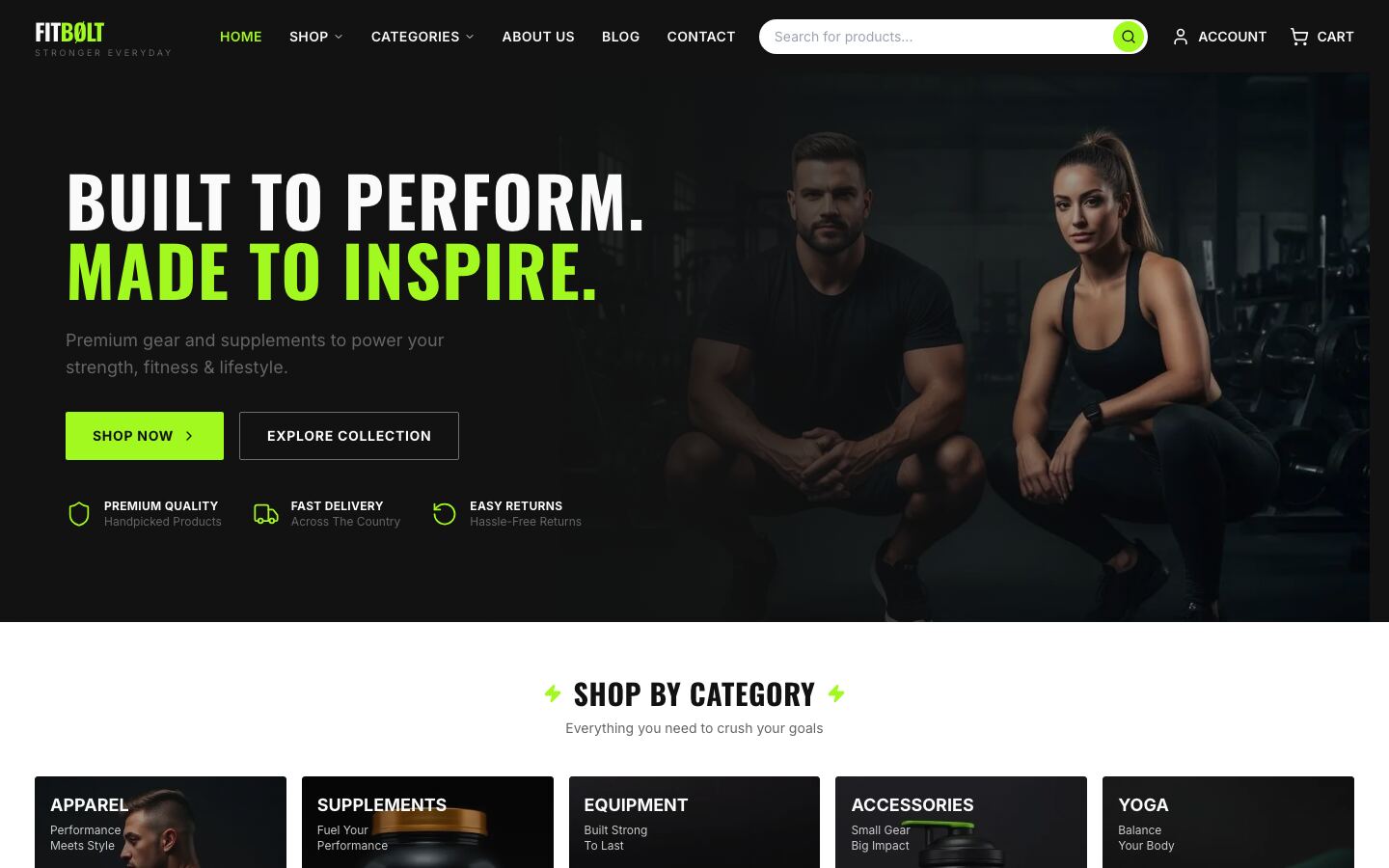
What's inside:
- A bold dark-and-neon design with condensed display headings, built for gyms, supplements and activewear
- A demo catalogue of 50 products for a fictional retailer, FitBolt, with 10 each in apparel, supplements, equipment, accessories and yoga
- A home page with a full-width hero, trust bar, category tiles, a best-sellers row, a sale banner, "why choose us" cards, testimonials and a newsletter block
- Category pages with badges (best seller, trending, new, top rated), star ratings, review counts, was/now prices and an Add to cart button on every card
- Product pages with breadcrumbs, a quantity picker, Add to cart and Buy now
- A cart and one-page checkout that share one shipping rule, so their totals always match, plus an order confirmation page
- Content pages: a blog with six articles, contact with FAQs, shipping, returns and a size guide
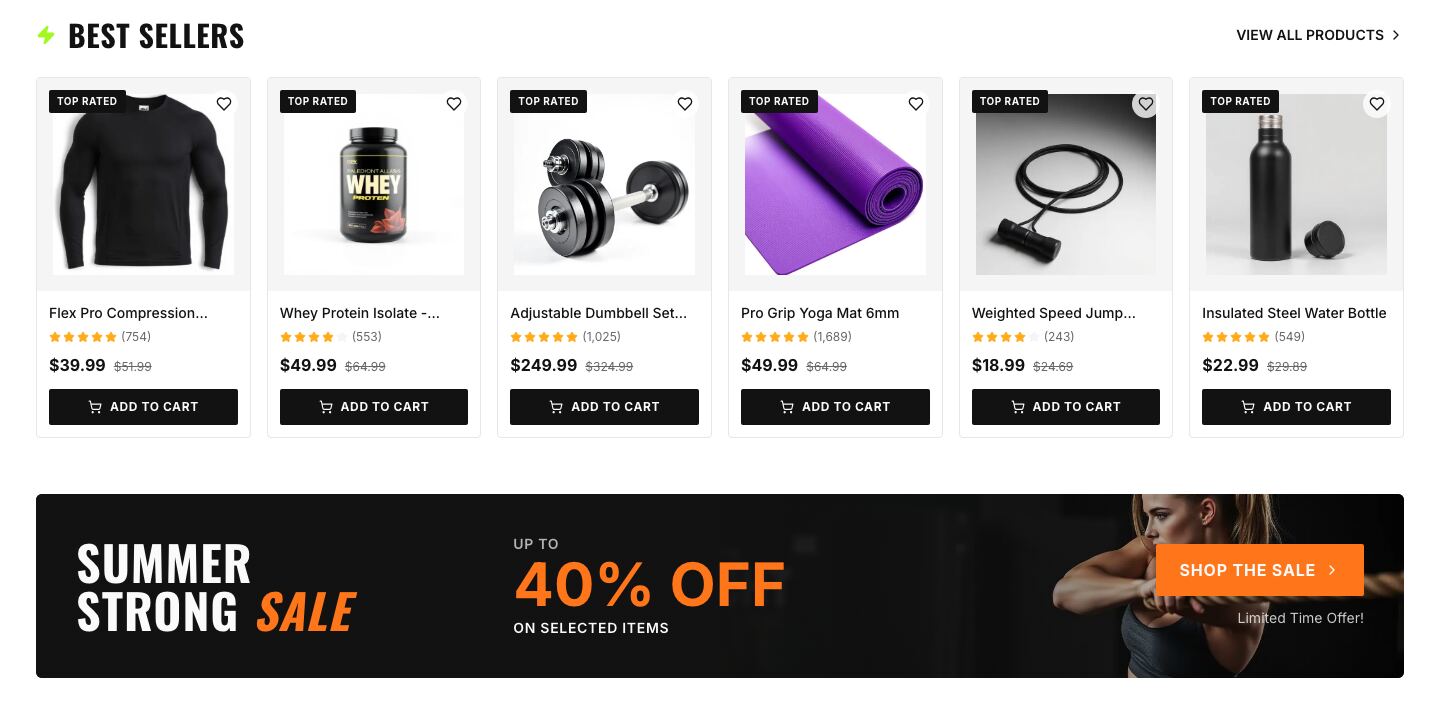
It runs straight away on its built-in demo catalogue, with no database. When you're ready for real orders, connect the open-source commerce backend it is built for, which you host yourself. One command loads the whole catalogue with stock, and its admin dashboard covers products, orders, customers, inventory and promotions. The backend adds promo codes, returns and replacements, stock adjustments and a low-stock report, and card payments work through Stripe once you add your keys. The setup guide in the download covers every step.
| Stack | Next.js 16, React 19, TypeScript, Tailwind CSS |
| Live demo | fitness-store.mvp.sale |
| Price | $39, one-time, with the full source code (a mobile app is available on request) |
| Get it | Fitness Store |
Your First 30 Days
| Week | Do this |
|---|---|
| 1 | Choose your lane and community. Order samples, test them, and check labelling and safety rules for what you'll sell. |
| 2 | Measure and photograph products, write size charts and fit notes, and work out packed weights and shipping costs. |
| 3 | Rebrand the store, load 20 to 40 products, connect payments, write returns rules per lane and place test orders. Go live. |
| 4 | Publish two beginner guides, contact three local gyms or clubs, send samples to a few small creators and start a 30-day challenge. |
FAQ
Is it better to start with activewear or supplements? Activewear is easier to ship and has fewer rules. Supplements bring repeat orders but need more care with labelling and claims. Pick the one that fits your community and budget.
Can I sell gym equipment without a warehouse? Yes. Many stores use suppliers that ship direct. Check delivery times, damage handling and who pays for returns before you list anything.
How do I reduce returns on clothing? Use a measurement-based size chart, fit notes, model sizes and reviews that mention fit. Most returns are size problems.
Start Your Fitness Store
Pick one lane, serve one community well, price shipping honestly and keep showing up with useful training content. That's how a small fitness store earns loyal customers.
See the Fitness Store or browse all ecommerce apps on MVPHub.
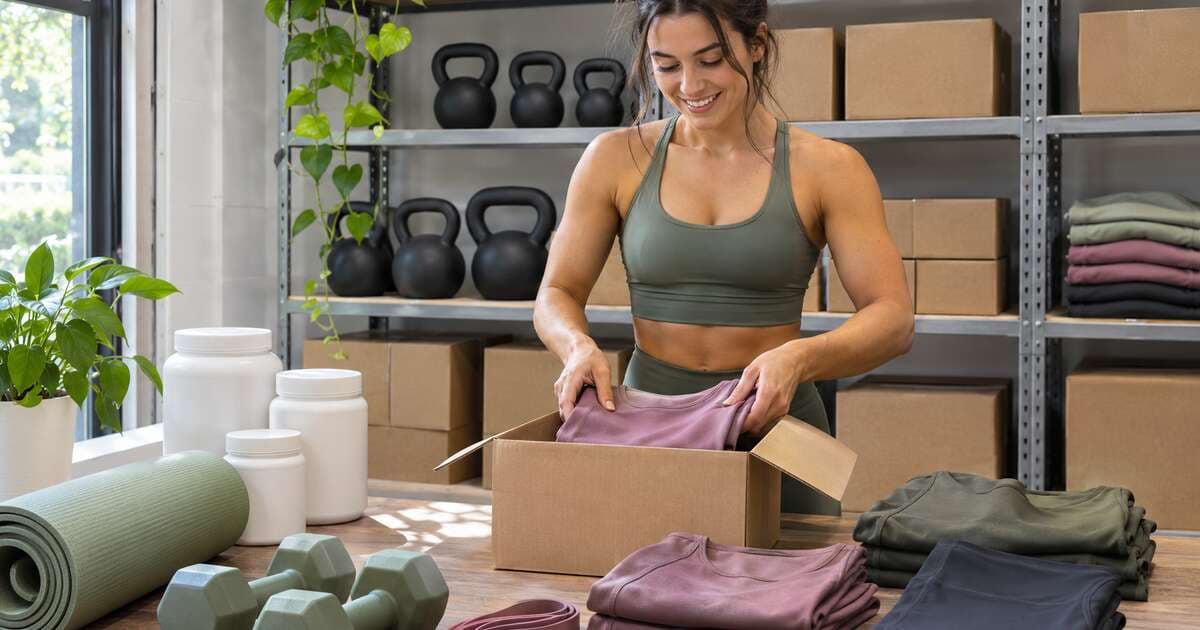
The cover image was created with AI image generation. The screenshots are from the Fitness Store demo.