How to Sell Plumbing Supplies Online: Trade, DIY and Fixtures
How to Sell Plumbing Supplies Online: Trade, DIY and Fixtures
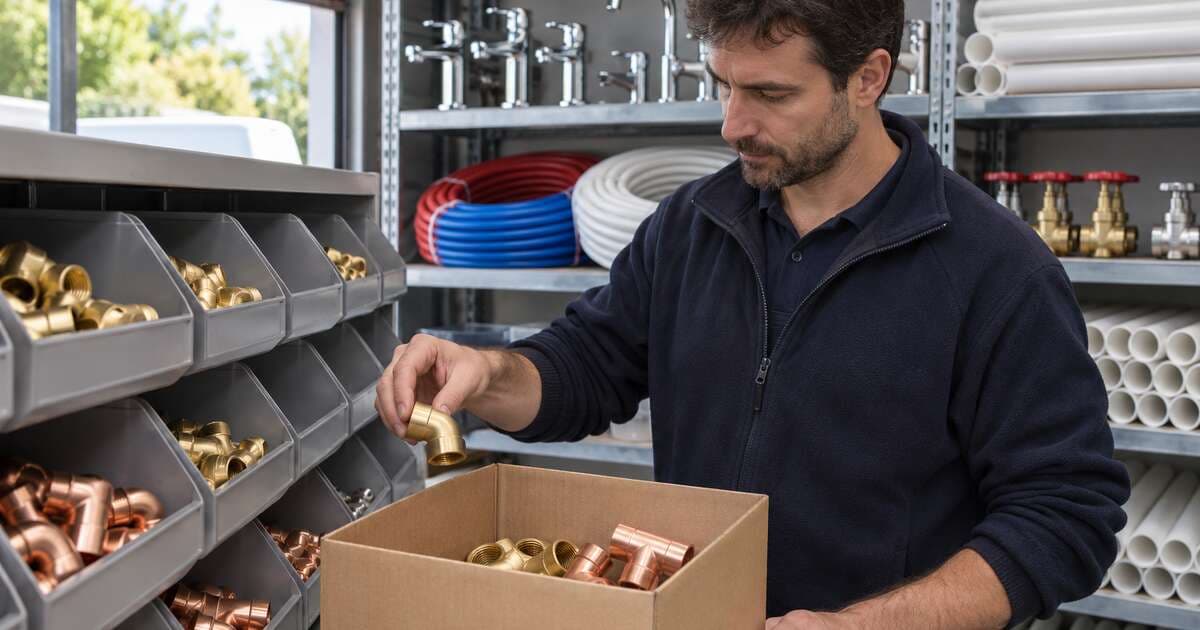
Plumbing is a category where the wrong part costs more than the part. A 15 mm fitting that should have been 20 mm, a tap that doesn't fit the basin hole, a cartridge for the wrong model: each one means a second trip, a delayed job and an unhappy customer. If you want to learn how to sell plumbing supplies online, that is the problem to solve. Stores that help people order the right part the first time win both the professionals and the weekend renovators.
This guide covers trade and DIY customers, what to sell, product data, pricing, click-and-collect, returns and SEO, then shows a ready-made storefront for plumbing fixtures.
Two Customers, One Store: Trade vs DIY
Most plumbing stores serve two very different buyers. Design for both from the start.
| Trade (plumbers, builders, maintenance teams) | DIY and renovators | |
|---|---|---|
| How they search | Part numbers, sizes, brand ranges | Problems: "leaking tap", "replace shower head" |
| What they value | Stock levels, speed, accurate data, account pricing | Clear explanations, photos, install help |
| Order pattern | Frequent, repeat, often urgent | Occasional, project-based, larger fixtures |
| Delivery | Same-day pickup or delivery to site | Home delivery, flexible timing |
| Price | Trade discounts, quantity breaks | Bundles, finish-matched sets |
Trade customers bring repeat volume. DIY customers bring higher-value fixture orders and search traffic. A good store lets the plumber find a part by code in seconds while helping the homeowner understand what they are buying.
Choose What You Sell
Plumbing covers a lot of ground. Pick a lane before you build a catalogue:
- Bathroom and kitchen fixtures. Taps, showers, basins, toilet hardware and accessories. Design-led, higher order values, photography matters.
- Pipe, fittings and valves. Thousands of small, low-cost parts. Accurate data and stock matter more than photos.
- Spare parts. Cartridges, washers, seals and flush valves. Customers search by model number and buy again.
- Tools and consumables. Thread tape, sealants, cutters and press tools. Good add-ons to every order.
- A specialist niche. Water filtration, outdoor taps, heritage fixtures, or parts for small homes and vans.
A common path is to start with fixtures or spare parts, where a small catalogue can still be useful, and add fittings as your supplier data improves.
How to Sell Plumbing Supplies Online With Product Data That Prevents Wrong Orders
In plumbing, product data is the product page. Make sure every item has:
| Data | Example | Why it matters |
|---|---|---|
| Part number and manufacturer code | Supplier code plus your SKU | Trade buyers search by code |
| Size and thread type | Nominal size, thread standard, male or female | The most common cause of wrong orders |
| Connection type | Compression, press-fit, push-fit, solder | Must match the existing system |
| Dimensions and cut-outs | Tap hole size, wall depth, basin footprint | Fixtures must fit the space |
| Pressure and flow | Working pressure range, flow rate | Some fixtures need minimum pressure |
| Finish | Chrome, brushed nickel, matte black, brass | Matching sets across a bathroom |
| Approvals and certifications | Standards or approval marks for your market | Many markets restrict what can be connected to drinking water |
| Compatibility | "Fits these cartridges", "works with these cisterns" | Saves a support call |
Approval rules for products connected to drinking water differ by country. Check the rules where you sell and only list products that meet them.
Get product data from your suppliers
You don't have to type thousands of specs by hand. Ask each supplier for:
- A product data file (spreadsheet or feed) with codes, sizes, dimensions and prices
- Spec sheets and installation instructions as PDFs
- Images you are allowed to use online
- Updates when products are discontinued or replaced
Then clean the data: use one name for each attribute ("Connection type", not five variations), keep units consistent, and turn the attributes shoppers filter by into proper filters. Start with the few hundred products you know sell, not the whole supplier catalogue.
Pricing: Retail, Trade and Bulk
Plumbing pricing has more layers than most retail:
- Retail price for the public.
- Trade price for approved account holders, often a percentage off retail or a separate price list.
- Quantity breaks. Fittings are often bought by the box or bag. Sell pack sizes, and show a lower unit price for larger quantities.
- Quotes for big jobs. A "request a quote" form for full bathroom or project orders keeps big buyers from leaving.
- Small-order fees or minimums if shipping single low-cost fittings loses money.
Fixtures usually carry better margins than commodity fittings, so use fittings to win trade loyalty and fixtures and finish-matched bundles to grow profit. For stock control across many small parts, see Inventory Basics for MVP Stores.
Click-and-Collect, Delivery and Packaging
Speed matters most to trade customers. A plumber who needs a valve today will drive to whoever has it on the shelf.
- Click-and-collect with a "ready in an hour" promise is a strong reason for trade buyers to order online first.
- Live stock levels stop wasted trips. Show "in stock at the counter" if you have a physical location.
- Parcel delivery suits fittings, parts and tapware.
- Freight for long pipe lengths, baths, vanities and hot water units, with clear delivery charges.
- Site delivery notes for builders: access, contact on site, delivery window.
Pack ceramics and plated finishes carefully. A scratched matte black tap is a return.
Returns and Wrong-Part Problems
Plumbing returns are mostly "wrong part", so the best returns policy is good data. Still, set clear rules:
- Accept unused, uninstalled items in original packaging within a set window.
- Say how special-order and cut-to-length items are handled.
- Ask customers to check dimensions and compatibility before ordering, and link to the install guide.
- Decide whether trade accounts get faster credit than retail returns.
Consumer rights for faulty goods differ by country. Check the rules where you sell.
Installation Guides as SEO Content
Plumbing has huge search demand for "how do I" questions. Every one is a chance to recommend the right part:
- "How to replace a tap cartridge" links to cartridges by model.
- "What size shower waste do I need?" links to wastes and drain covers.
- "How to choose a basin mixer for a countertop basin" links to tall mixers and basins.
Write short, accurate guides with diagrams and a parts list at the end. Many places require a licensed plumber for some work, so say when a job needs a professional, and check the rules where you sell.
On the catalogue side, give each category page a short intro and keep filters in clean URLs. For the full approach, see Marketplace SEO Strategy: How to Rank Your Category Pages.
Marketing to Trade and DIY Buyers
For trade: visit local plumbers and builders, offer an account with a simple discount, and send a monthly email with new ranges and stock updates. Reliable stock and fast pickup earn repeat orders.
For DIY: publish renovation inspiration, before-and-after projects and short repair videos. Finish-matched bundles ("everything in brushed brass") make a bathroom project feel easy.
For both: reviews that mention fit and installation are gold. Ask for them a few weeks after delivery, once the product is installed.
Launch Faster With Plumbing Store, a Ready-Made Next.js Storefront
Plumbing Store is a storefront for bathroom and plumbing fixtures: tapware, shower systems, basins, toilet hardware and finish-matched accessories, in a navy-and-brass design with serif headings.
What's inside:
- A home page with a full-screen hero, a trust bar (free shipping, warranty, returns, support), category tiles and featured fixtures
- Category landing pages for faucets, showers, basins, toilets and accessories, plus shop and sale pages
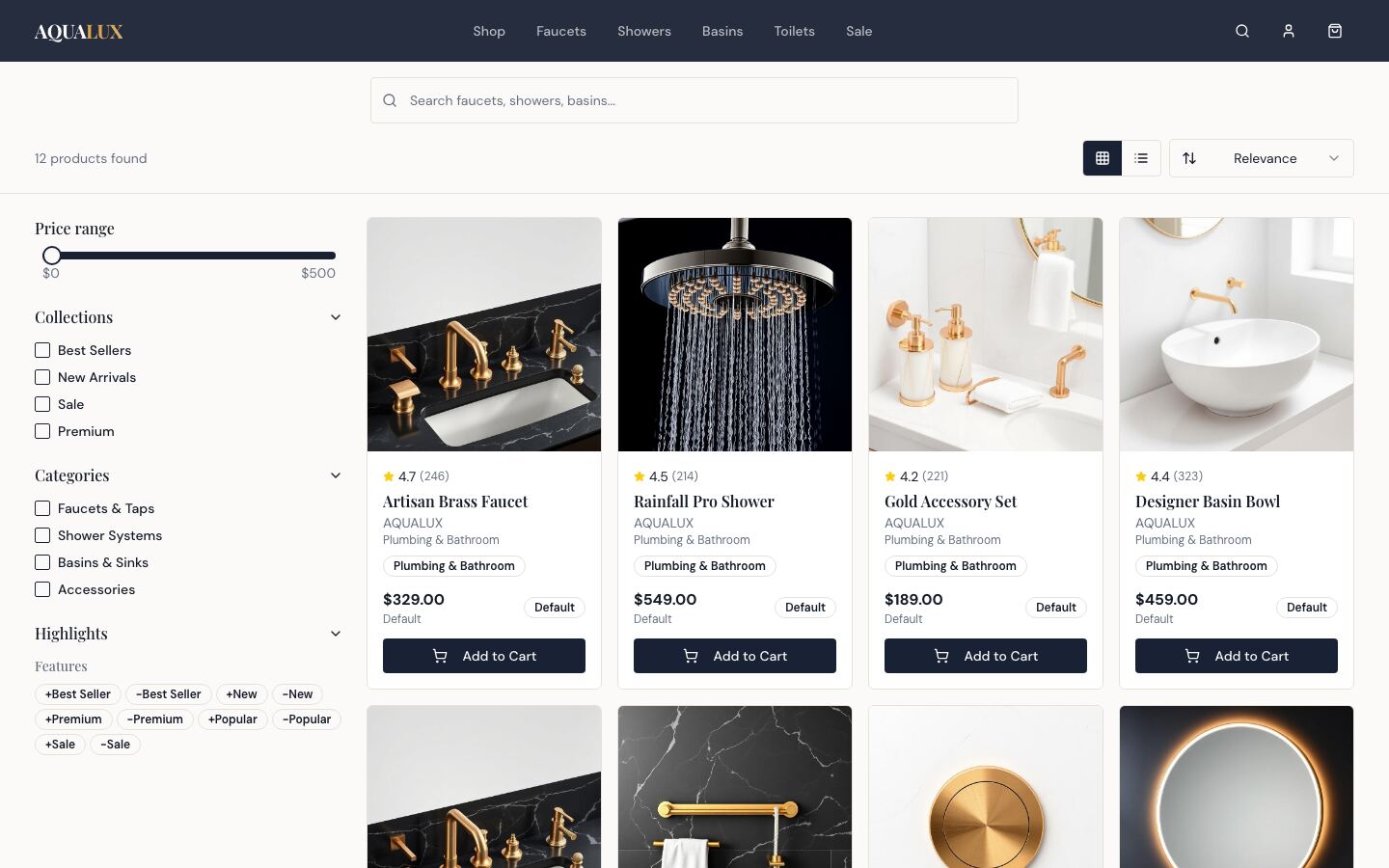
- Search and filters for price, collection, category and highlights, with sorting and grid or list views
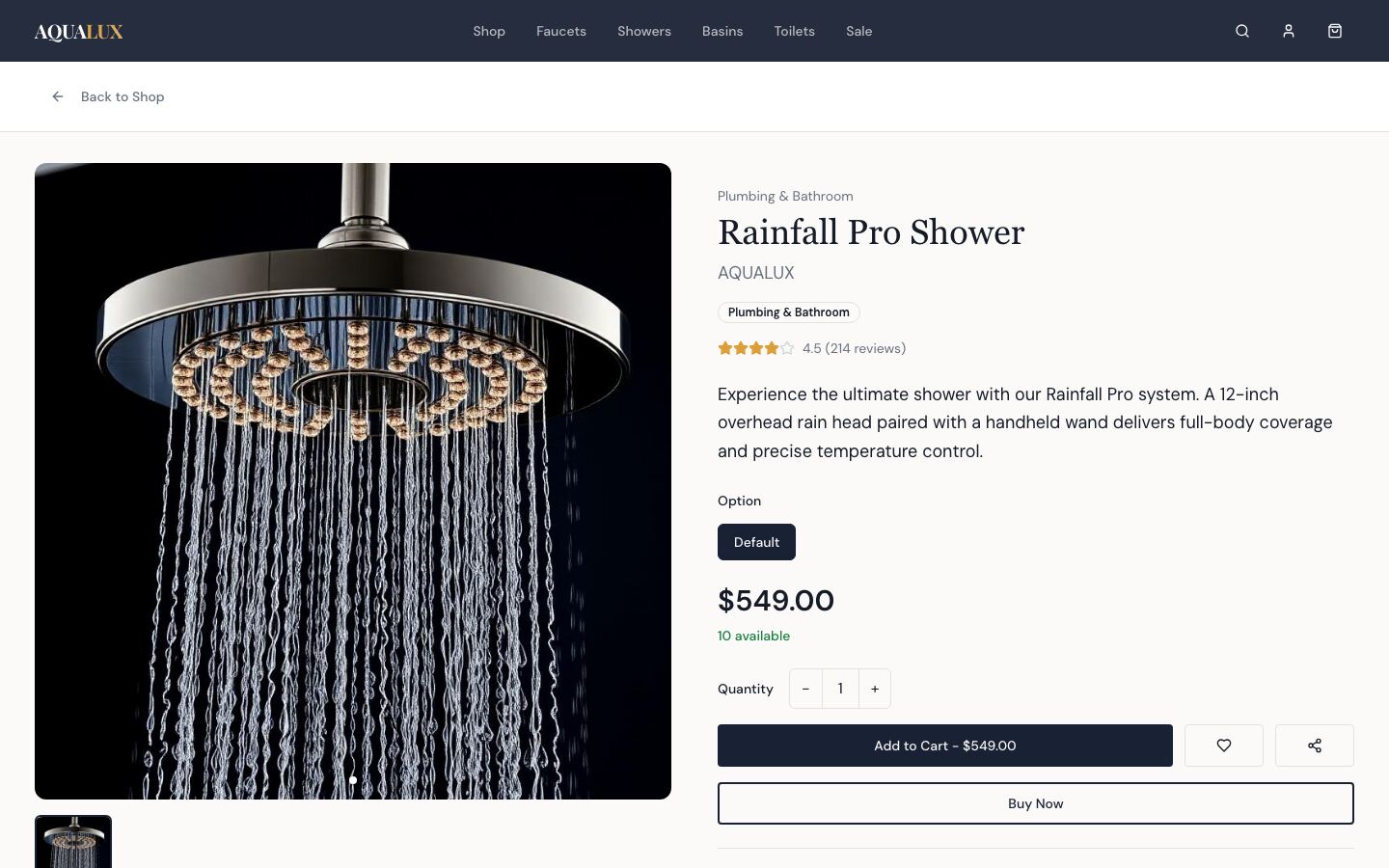
- Product pages with a gallery, finishes and sizes that each have their own price and stock, highlights, reviews, related fixtures and Product structured data
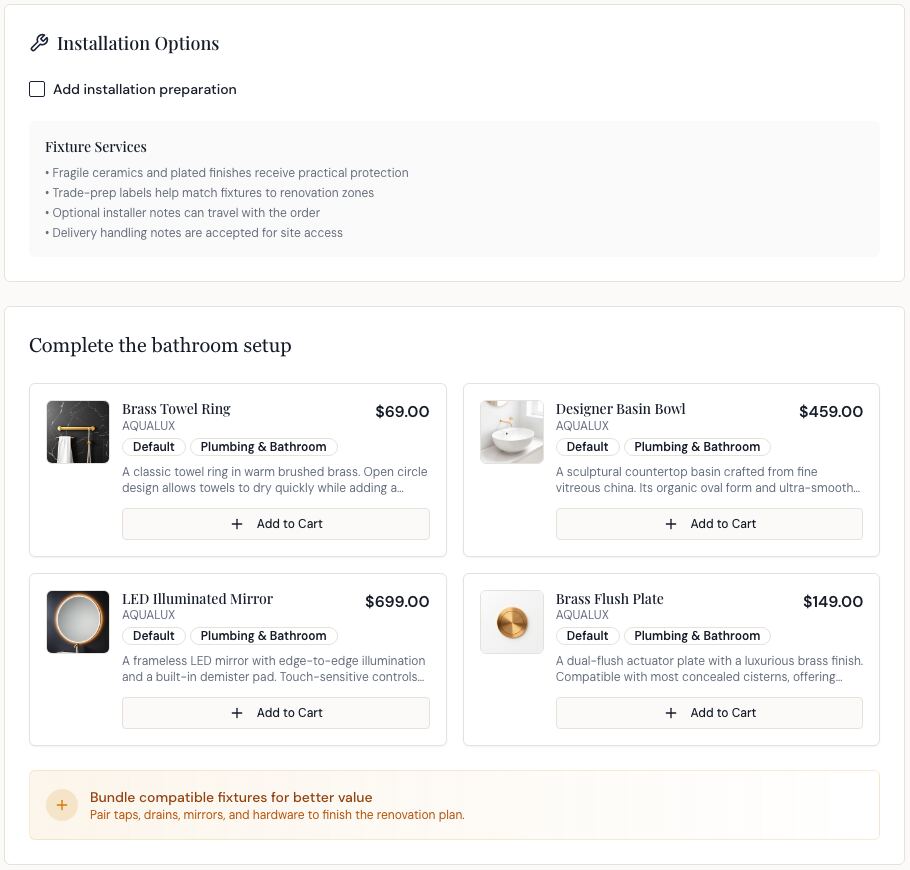
- A cart for fixtures: an optional installation-preparation service (protective packing, labelled trade prep and site delivery notes), promo codes, a free-shipping progress bar and "complete the bathroom" suggestions
- Step-by-step checkout with Stripe card payments when you add your keys
- Content pages: install guide, showrooms, trade, blog, shipping and returns, ready for your own copy
It runs straight away on a built-in demo catalogue, with no database. For real orders, connect the open-source commerce backend it is built for, which is included and you host yourself. The catalogue file gives every finish and size its own SKU, and you get an admin dashboard for products, orders, customers, inventory and promotions, plus order look-up, return and replacement requests and a low-stock report. Trade accounts, trade price lists and click-and-collect are not built in; the trade and showroom pages are where you would add them.
| Stack | Next.js 16, React 19, TypeScript, Tailwind CSS, shadcn/ui |
| Live demo | plumbing-store.mvp.sale |
| Price | $39, one-time, for the Next.js Storefront with full source code |
| Get it | Plumbing Store |
A mobile app and versions for other frameworks are available on request.
Your First 30 Days
| Week | Do this |
|---|---|
| 1 | Choose trade, DIY or both, and pick your first range. Request product data files, spec sheets and image rights from suppliers. |
| 2 | Clean the data: part numbers, sizes, connections, finishes and compatibility. Set retail prices, pack sizes and delivery rates. |
| 3 | Rebrand the storefront, load your products, connect payments and publish three install guides. Go live. |
| 4 | Visit local trade customers, start a monthly stock email, and check which searches return no results. Add those products next. |
FAQ
Do I need a warehouse to sell plumbing supplies online? Not at first. Many stores start with supplier dropship or a small stock of fast-moving parts, then add a trade counter once demand is clear.
Should I sell to trade or DIY customers first? Pick the one you can serve best. If you have trade relationships and stock, start there. If you are strong on content and design, fixtures for renovators may be easier.
How do I stop customers ordering the wrong part? Publish sizes, thread and connection types, dimensions and compatibility on every product, and link install guides from product pages.
Start Selling Plumbing Supplies Online
The plumbing stores that win online are the ones that make ordering the right part easy. Get the data right, serve trade and DIY buyers on their own terms, and let your guides bring in the searches.
See Plumbing Store or browse all ecommerce apps on MVPHub.
The cover image was created with AI image generation. The screenshots are from the Plumbing Store demo.