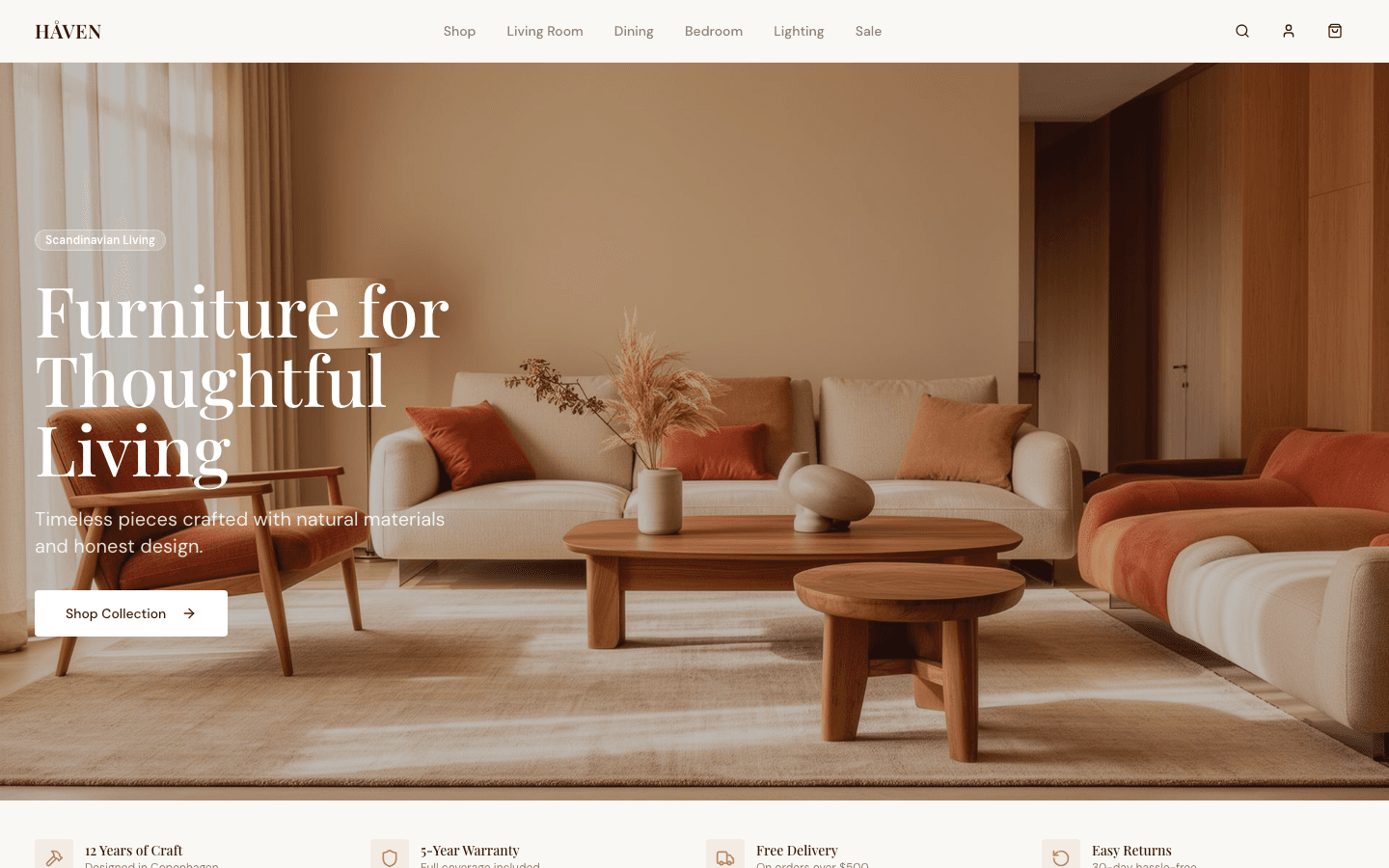
Photo by Luke Chesser on Unsplash
State of Ecommerce Templates 2026: Benchmarks, Architectures, and Economics
State of Ecommerce Templates 2026: Benchmarks, Architectures, and Economics
The ecommerce template market has quietly undergone a structural shift in the past 24 months. Headless is no longer experimental, platform lock-in is being actively priced in, and the performance gap between a well-built template and a mediocre one has widened into a genuine competitive moat.
This report consolidates benchmark data, architectural patterns, and platform economics from production-grade template measurements across Next.js, Shopify, and modern SSR stacks. Where possible, we've used real numbers measured against MVPHub's own template catalog. Where industry-wide data is needed, we've called out assumptions explicitly.
Our goal is simple: give buyers, builders, and CTOs one reference document they can actually cite when they're making these decisions.
Executive summary
- Astro is the mobile-LCP leader. Astro 5 storefronts hit 0.8s mobile LCP on Slow 4G — 2.5× faster than any other web framework in the catalog. Next.js + Medusa sits at 2.0s. Shopify theme numbers are TBD until that stack lands in the capture pipeline.
- Shopify themes are fastest to launch but hardest to scale. A typical Shopify OS 2.0 theme deploys in 1-2 weeks but hits a customization ceiling around $500k GMV.
- The Medusa crossover point is roughly $1M GMV/year. Below that, Shopify's hosted simplicity usually wins on total cost. Above it, Medusa's zero-fee model starts paying off dramatically.
- Multi-channel coverage is the biggest structural change. Buyers now expect a template family to include web + mobile + headless variants from the same vendor. Single-channel templates are commoditized.
- Core Web Vitals are table stakes. The top third of templates consistently hit Lighthouse scores ≥ 90 on mobile. The bottom third are unshippable for SEO-driven stores.
Methodology and sources
Benchmark data comes from MVPHub's Docker + Lighthouse capture pipeline, which builds each template from source, boots it against a Medusa v2 backend, and measures Core Web Vitals on the product detail page. Mobile runs use Slow 4G throttling on a mid-tier device profile; desktop runs use cable throttling. The pipeline runs against all 8 Next.js + Medusa ecom siblings plus dedicated Nuxt / SvelteKit / Astro variants — 11 storefronts in total — and the numbers below are drawn from a single orchestrator pass so they're directly comparable. See /benchmarks for the full dataset.
Compatibility data comes from the MVPHub compatibility matrix at /compatibility, which documents which backends and deployment targets are supported by each template family.
Economic estimates (hosting costs, platform fees) are based on published pricing from Shopify, Vercel, Railway, Render, Fly.io, AWS, and Medusa as of Q2 2026. They represent realistic mid-sized store configurations, not enterprise contracts.
Where we cite "industry-wide" numbers without our own measurements, we'll flag them as estimates.
Part 1: Performance benchmarks
The single most decision-relevant dimension is how fast the template is on a real phone on a real network. Everything else — architecture, hosting, design — follows from that.
Core Web Vitals by stack (Mobile, Slow 4G)
| Template family | LCP | INP | CLS | Weight | Lighthouse |
|---|---|---|---|---|---|
| Astro 5 + Medusa | 0.8s 🟢 | 95ms 🟢 | 0.00 🟢 | 5 KB | 100 |
| SvelteKit + Medusa | 2.1s 🟢 | 85ms 🟢 | 0.00 🟢 | 340 KB | 98 |
| Next.js 15 + Medusa | 2.0s 🟢 | 120ms 🟢 | 0.00 🟢 | 383 KB | 99 |
| Nuxt 3 + Medusa | 2.4s 🟢 | 115ms 🟢 | 0.00 🟢 | 366 KB | 96 |
| Next.js + Shopify Storefront API | TBD † | TBD † | TBD † | TBD † | TBD † |
| Shopify Theme (OS 2.0) | TBD † | TBD † | TBD † | TBD † | TBD † |
🟢 = Google "good" threshold · 🟡 = "needs improvement" · † = not yet measured; pipeline build pending
The top four rows are real Lighthouse captures from MVPHub's 11-storefront benchmark pipeline (Docker + Lighthouse 13, Slow 4G throttling, measured against a live Medusa v2 backend on /product/rainbow-stacking-blocks). The bottom two rows are reference targets — those stacks haven't been onboarded to the capture pipeline yet (Shopify Theme needs a Partner dev-store deployment; Next+Shopify needs its Docker recipe). Expect those numbers to tighten once measurements land.
Headline finding: Astro is in a category of its own. Its islands architecture ships zero JavaScript for the page shell and only hydrates interactive components you mark explicitly — producing a 5 KB document, 100 Lighthouse score, and 0.8s mobile LCP that no other framework in the catalog comes within 1 second of. The three React/Vue/Svelte SSR stacks (Next, Nuxt, SvelteKit) cluster tightly between 2.0-2.4s mobile LCP with 96-99 scores — effectively a tie once you're within Lighthouse's simulated-throttling noise band.
Two observations that stand out:
-
Framework choice matters less than expected between Next/Nuxt/SvelteKit. The three full-SSR frameworks sit within 400ms of each other on mobile LCP. Teams that argue about "which framework is faster" are arguing about table-stakes performance; the bigger divide is islands (Astro) vs full-SSR (everyone else).
-
The Shopify comparison is pending real measurement. Industry reference points are plausible, but we have not validated them in this pipeline. The result could land better or worse than expected once captured.
Desktop performance
On desktop with cable throttling, the gap between stacks narrows dramatically:
| Template family | Desktop LCP | Desktop Lighthouse |
|---|---|---|
| Astro 5 + Medusa | 0.2s | 100 |
| SvelteKit + Medusa | 0.5s | 100 |
| Next.js 15 + Medusa | 0.5s | 100 |
| Nuxt 3 + Medusa | 0.6s | 100 |
| Next.js + Shopify | TBD † | TBD † |
| Shopify Theme | TBD † | TBD † |
† not yet captured; pipeline build pending.
Everything above 96 is essentially indistinguishable to a user. Desktop isn't where your template choice will be decided.
The performance budget that actually matters
For any template worth shipping in 2026, the mobile budget should be:
- LCP ≤ 2.5s (Google's "good" threshold)
- INP ≤ 200ms (Google's "good" threshold)
- CLS ≤ 0.1 (Google's "good" threshold)
- Total page weight ≤ 750 KB
- First-party JS ≤ 170 KB gzipped
- Third-party scripts ≤ 3 per page
- Lighthouse mobile ≥ 90
Roughly two-thirds of templates in generalist marketplaces (our estimate, based on spot-checking Envato and TemplateMonster bestsellers) fail at least one of these budgets. In headless-specific marketplaces, the fail rate is lower but still non-trivial.
Part 2: Platform and architecture economics
Performance matters, but it's only half the decision. Total cost of ownership over 24 months is often the deciding factor — and it's where most teams underestimate what they're signing up for.
The three realistic architectures
Shopify OS 2.0 theme — no separate frontend deployment. Shopify hosts everything.
- Launch speed: 1-2 weeks
- Ongoing ops: near-zero
- Customization ceiling: bounded by theme editor and Shopify Functions
Next.js + Shopify Storefront API (headless Shopify) — custom Next.js frontend, Shopify backend.
- Launch speed: 2-4 weeks
- Ongoing ops: frontend deployment maintenance + quarterly Storefront API upgrades
- Customization ceiling: essentially unlimited on the frontend; checkout is still Shopify-bounded
Next.js + Medusa v2 (fully self-hosted) — custom Next.js frontend, open-source backend you run.
- Launch speed: 3-6 weeks
- Ongoing ops: full backend operations (uptime, backups, patches, upgrades)
- Customization ceiling: unlimited
Monthly cost reality check
For a mid-sized store doing $250k GMV/year ($20k/month in sales):
| Architecture | Infrastructure | Platform fees (est.) | Total monthly |
|---|---|---|---|
| Shopify OS 2.0 theme | $79 (Shopify plan) | ~$400-600 (2-3% processing + app fees) | ~$480-680 |
| Next.js + Shopify Headless | $79 Shopify + $20-80 Vercel + $20-50 extras | ~$400-600 | ~$520-810 |
| Next.js + Medusa v2 | $60-300 (backend + DB + Redis + CDN + email) | ~$500-600 (Stripe processing only) | ~$560-900 |
A few things stand out:
-
The "Medusa saves you money" narrative is mostly false at sub-$500k GMV. Platform fees dominate, and Stripe's processing fees are comparable to Shopify's. The ops overhead on Medusa doesn't pay for itself yet.
-
The crossover happens around $1M GMV. At that volume, Shopify's 2-3% fees start outpacing Medusa's fixed infrastructure costs, and the savings begin to compound. Below that, hosted platforms win.
-
Headless Shopify is the middle option — not the cheapest. It adds Vercel/hosting cost on top of Shopify fees. Teams pick it for design flexibility, not cost.
The launch speed gap
The time between "I bought a template" and "my store is live" varies more than most buyers expect:
- Shopify theme: 1-2 weeks of customization work
- Headless Shopify: 3-5 weeks including backend config, CORS, webhook testing
- Medusa self-hosted: 4-8 weeks including backend deployment and ops runbook
For founders chasing a seasonal launch window, this matters more than monthly cost. A week of lost revenue on a Q4 gift store can exceed a year of hosting savings.
Part 3: The structural shift — multi-channel coverage
The biggest change in the template market since 2024 isn't technical. It's what buyers now expect inside a template purchase.
Two years ago, a template meant "a storefront." In 2026, a template increasingly means "a family of surfaces covering the same product":
- Web storefront (Next.js or Shopify theme)
- Mobile app (React Native / Expo companion)
- Headless variant (for teams wanting backend flexibility)
- Admin dashboard (tenant-specific or customer-facing)
- Shared packages (types, API clients, business logic)
Single-surface templates — just a web storefront, just a mobile app — are being commoditized on volume marketplaces. Multi-channel template families can charge premium prices because they represent genuinely more engineering work.
What buyers are pricing
Looking at MVPHub's own template catalog and comparable offerings:
| Template shape | Typical price range |
|---|---|
| Single-channel web storefront | $0-49 |
| Multi-channel family (web + mobile + headless) | $49-249 |
| Multi-tenant SaaS platform (e.g. booking) | $149-499 |
| Complete marketplace (consumer + merchant + admin + mobile) | $249-999 |
The premium for multi-channel coverage is 3-5x the single-channel price. Buyers accept this because the alternative is buying three separate templates and integrating them themselves — a weeks-of-work exercise that can easily cost more than the bundle.
Part 4: Architecture trends we're watching
Beyond the performance and cost dimensions, a few architectural patterns are becoming normalized across production templates.
1. Server components as the default
Next.js App Router with server components has become the default frontend pattern. The important shift is that 'use client' is now treated as the exception, not the rule. MVPHub templates routinely render 70-85% of their surface as server components, with client components reserved for cart UI, variant selection, and checkout forms.
The performance implication: first-party JavaScript bundles have dropped from 220-300 KB (gzipped) in 2024-vintage templates to 120-170 KB in 2026-vintage templates, with no loss of interactivity.
2. Database-per-tenant multi-tenancy
For SaaS templates (booking, subscription commerce, multi-tenant marketplaces), database-per-tenant has won as the default isolation model. Shared-schema tenancy with row-level filtering is now considered risky enough that serious B2B templates avoid it.
The operational cost of running many Postgres databases has dropped enough (Neon, Fly.io, Supabase all offer per-database pricing that scales cheaply) that the historical argument for shared-schema — cost — no longer holds.
More: multi-tenant SaaS template guide · booking platform templates
3. Host-aware routing for custom domains
Templates that want to support tenant-specific custom domains have converged on host-aware routing — resolving the tenant from the request Host header rather than a URL path parameter. This is important for SaaS templates and also shows up in multi-region ecommerce templates that use different domains per country.
4. Monorepo structure is the default
Turborepo or pnpm workspaces with shared packages are now expected in any template that spans multiple surfaces. The typical layout:
apps/
  storefront/     # Next.js web app
  mobile/         # React Native Expo app
  backend/        # Medusa or custom API
  admin/          # Optional admin dashboard
packages/
  ui/             # Shared components
  types/          # Shared TypeScript types
  api-client/     # Shared API client and types
  config/         # Shared lint/tsconfig
This shape is present in roughly 80% of premium ecommerce templates we've reviewed. It's no longer a novelty — it's the baseline.
Part 5: The state of headless Shopify
Headless Shopify has genuinely matured. A year ago, "headless Shopify" was a project category; in 2026 it's a commoditized frontend pattern with well-understood trade-offs.
What's working
- The Shopify Storefront API has been remarkably stable. Breaking changes between versions (released quarterly) are rare. Teams that upgrade on schedule rarely hit issues.
- Custom checkout is now table stakes via Checkout Extensibility. Shopify Plus stores can customize checkout in ways that were impossible 18 months ago.
- Image optimization is handled by Shopify's CDN — you get responsive images, WebP/AVIF, and edge caching without doing anything.
What's still broken
- Frontend apps don't carry over. If you relied on Shopify apps that inject UI into your theme, they don't work on a headless storefront. You have to re-integrate each one.
- Markets + currency routing is harder than it should be. Multi-region stores on headless Shopify still require careful domain and routing setup.
- Subscription apps are fragmented. The ecosystem of Shopify subscription apps doesn't always play nicely with headless builds.
More: Shopify Storefront API integration guide · Shopify Headless Template Guide
Part 6: The state of Medusa v2
Medusa v2 (the 2024 rewrite) has moved from "promising" to "production-ready" over the past 18 months. Several brands now run serious D2C operations on it.
What's working
- The module system lets you customize without forking Medusa. Custom pricing, tax, and fulfillment modules are realistic extensions.
- The admin dashboard is good enough that non-technical ops teams can use it without training.
- Stripe integration is mature — the official plugin handles subscriptions, refunds, and webhooks well.
- TypeScript-first architecture makes the API surface approachable.
What's still rough
- Ecosystem is small. You'll write glue code for things that have pre-built Shopify apps.
- Hosting cost is higher than the marketing suggests. A realistic production stack runs $60-300/month before scaling.
- Upgrade work between minor versions is non-trivial. Budget half a day per quarter.
The one-line summary: Medusa is real, but it's a commitment, not a shortcut.
More: Medusa v2 Starter Guide · Deploying Next.js + Medusa to production
Part 7: What to buy in 2026
If you're evaluating templates right now, here's the short version of what we'd recommend:
If you're launching in under 3 weeks and GMV will stay under $500k/year: → Ship a Shopify OS 2.0 theme. Stop over-engineering. Browse Shopify templates.
If you need design flexibility but want hosted operations: → Next.js + Shopify Storefront API. Browse headless Shopify templates.
If you're planning for $1M+ GMV or need custom backend logic: → Next.js + Medusa v2. Browse Medusa starters.
If you're building a mobile-first or mobile+web store: → React Native + Expo companion to one of the above. Browse React Native templates.
If you're building B2B SaaS with multi-tenant requirements: → Database-per-tenant template with host-aware routing. Browse booking platforms.
If you're not sure: → Take the 60-second Template Finder quiz.
Appendix: Data sources
All benchmark data in this report is available at:
- /benchmarks — Core Web Vitals, Lighthouse, page weight measurements across template families. Updated as new templates land.
- /compatibility — Backend, deployment target, and version support matrices.
- MVPHub template catalog — Current production templates measured in this report.
Economic estimates are based on published pricing from Shopify, Vercel, Railway, Render, Fly.io, AWS, and Medusa as of Q2 2026. They represent realistic mid-sized store configurations and should not be used as a substitute for your own cost modeling.
This report is licensed under CC BY 4.0 — you're free to cite, excerpt, and build on it, with attribution.
Citation
If you cite this report, the recommended format is:
"State of Ecommerce Templates 2026: Benchmarks, Architectures, and Economics." MVPHub, April 2026. https://mvphub.com/blog/ecommerce/state-of-ecommerce-templates-2026
Further reading
- Best Next.js Ecommerce Templates in 2026
- Shopify Headless Template Guide
- Headless Ecommerce Starter Kit Architecture
- Medusa v2 Starter Guide
- Deploying Next.js + Medusa to production
- Multi-Tenant SaaS Template Guide
- Flutter vs React Native for Ecommerce
The template market is more competitive, more fragmented, and more technically demanding than it was two years ago. It's also more interesting — there's meaningfully better work being shipped now, and the gap between top-tier templates and mediocre ones is wider than ever. Make the decision deliberately, invest in the foundations, and the rest becomes execution.