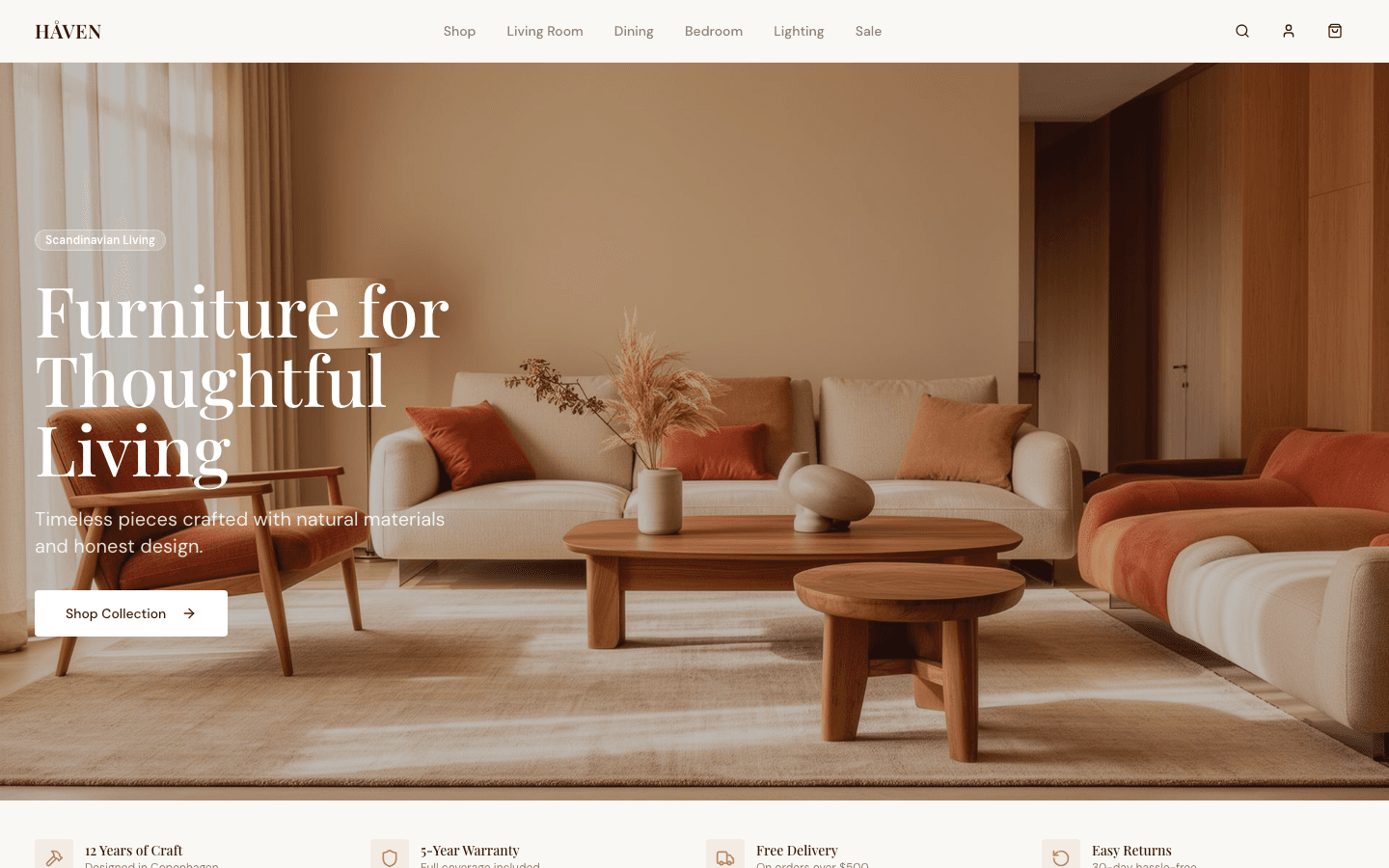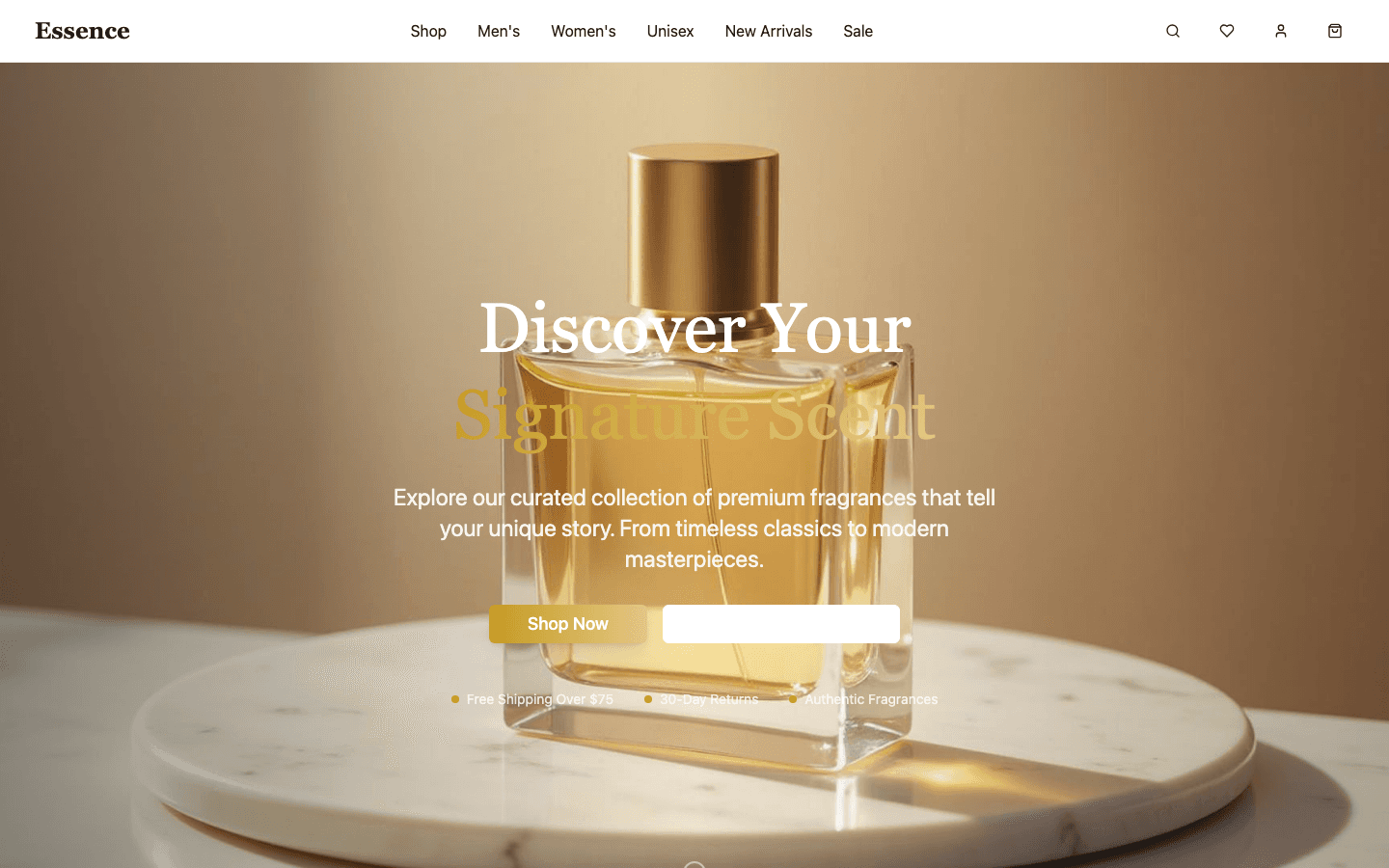
Nuxt Ecommerce Templates: Headless Vue Storefronts for 2026
Nuxt Ecommerce Templates: Headless Vue Storefronts for 2026
Nuxt 3 is the Vue equivalent of Next.js for production ecommerce. Same SSR ceiling, same feature set, same deployment story — just with Vue components and the Composition API instead of React. If your team writes Vue, Nuxt is the strictly better choice. This guide walks through the architecture, the decision points, and what to look for in a production Nuxt ecommerce template.
TL;DR
- Nuxt 3 is production-ready for ecommerce — used by Louis Vuitton, NASA, Upwork, and many D2C brands
- SEO is equivalent to Next.js — server-side rendering by default, ISR via route rules, full support for every meta tag pattern
- Performance is within measurement noise of Next.js (2.4s vs 2.0s mobile LCP on the latest measured run) — Vue 3's runtime is slightly smaller than React's but the difference is dominated by image, font, and data-fetching costs common to both frameworks
- Ecosystem is smaller than React — this is the main trade-off, not SEO or performance
- Pair Nuxt with Medusa for the full-stack open-source setup, or with Shopify Storefront API for headless Shopify on Vue
Browse Nuxt ecommerce templates
Why Nuxt for ecommerce
Nuxt gives you every Next.js advantage translated to Vue:
Server-side rendering by default. Every page renders HTML on the server and sends it to the browser fully-formed. Google indexes product pages on first crawl. Social cards render correctly. Lighthouse scores sit comfortably in the "good" CWV zone.
Hybrid rendering via route rules. Nuxt 3's routeRules config lets you pick rendering mode per route without rewriting pages:
// nuxt.config.ts
export default defineNuxtConfig({
  routeRules: {
    '/': { prerender: true },                   // SSG — homepage
    '/products/**': { isr: 600 },               // ISR — product pages, revalidate every 10 min
    '/cart': { ssr: false },                    // SPA — cart is client-only
    '/admin/**': { ssr: false, robots: false }, // SPA + noindex
  },
})
This is arguably cleaner than Next.js's server-component-by-default + "use client" opt-out model. You declare rendering intent in one place.
Auto-imports everywhere. Components, composables, and utilities under components/ and composables/ are auto-imported. You stop writing import statements for your own code.
Pinia for state. The official Vue state library. Lightweight, TypeScript-first, no mutations or modules boilerplate. MVPHub Nuxt templates use Pinia for cart state, user session, and anywhere else state outlives a single component.
Architecture: Nuxt + Medusa
Every Nuxt ecommerce template on MVPHub ships with a Medusa v2 backend integration. The data flow looks like this:
Browser
  ↓ HTML request
Nuxt server (Node.js / Nitro runtime)
  ↓ Medusa JS SDK call
Medusa backend (REST + GraphQL)
  ↓ SQL
PostgreSQL + Redis
The server-side useAsyncData composable fetches product data during SSR, and the rendered HTML goes straight to the browser. Client-side Vue hydrates and takes over for cart interactions.
Product page example:
<!-- pages/products/[handle].vue -->
<script setup lang="ts">
const route = useRoute()
const { data: product } = await useAsyncData(
  `product:${route.params.handle}`,
  () => $fetch(`/api/products/${route.params.handle}`)
)

if (!product.value) {
  throw createError({ statusCode: 404, message: 'Product not found' })
}

useSeoMeta({
  title: product.value.title,
  description: product.value.description,
  ogImage: product.value.thumbnail,
})
</script>

<template>
  <article>
    <h1>{{ product.title }}</h1>
    <ProductGallery :images="product.images" />
    <ProductVariantPicker :variants="product.variants" />
    <AddToCartButton :product="product" />
  </article>
</template>
Note what's NOT here:
- No explicit
importstatements — components auto-imported - No React-style hooks — Composition API's
useAsyncDatahandles data fetching - No server-component/client-component split — Nuxt handles SSR + hydration transparently
- No manual
<head>manipulation —useSeoMetais a typed composable that handles it
Performance: Nuxt vs Next.js
Nuxt and Next.js are within measurement noise of each other on every benchmark we run. See /benchmarks for the raw numbers.
Mobile product page (Slow 4G throttling):
| Metric | Next.js + Medusa | Nuxt + Medusa |
|---|---|---|
| LCP | 2.0s | 2.4s |
| INP | 120ms | 115ms |
| CLS | 0.00 | 0.00 |
| First-party JS | ~150 KB | ~140 KB |
| Lighthouse score | 99 | 96 |
Next.js and Nuxt come out essentially tied — mobile LCP is within ~400ms, Lighthouse scores within 3 points, JS bundles within 10 KB. That gap sits inside Lighthouse's simulated-throttling noise band; consecutive runs of the same template can swing 200-300ms either way. For most stores this is rounding error; the real performance decisions are about image optimization, font loading, and third-party scripts — concerns that apply equally to both frameworks.
Hybrid rendering strategy
A well-configured Nuxt ecommerce site uses different rendering modes for different route groups:
| Route | Rendering | Why |
|---|---|---|
/ (homepage) | SSG | Content is curated, updates rarely |
/about, /shipping, /returns | SSG | Static content pages |
/products/[handle] | ISR (10 min) | Product data changes; 10-minute freshness is fine |
/collections/[handle] | ISR (10 min) | Same reasoning |
/cart | SPA (no SSR) | Per-user state, no SEO value, fully client-side |
/account/** | SPA (no SSR) | Authenticated, no SEO value |
/checkout | SSR (per request) | Per-user state that MUST be server-rendered for security |
/blog/** | SSG | Content pages, regenerated on publish |
Every MVPHub Nuxt template ships with this structure preconfigured.
When Nuxt beats Next.js
- Your team writes Vue. This is the one scenario where Nuxt is strictly better. Retraining a Vue team to React costs more than the ecosystem gap ever will.
- You want the cleanest hybrid rendering config. Nuxt's
routeRulesis a single-file declaration that Next.js doesn't match. - You want smaller JS bundles. Vue 3's runtime is 5-10% smaller than React 19's. Marginal for most stores but measurable.
When Next.js beats Nuxt
- Your team writes React. Don't retrain for a single project.
- You need a specific React-only library — some commerce integrations (Shopify Hydrogen, certain headless CMS clients) ship React examples first.
- You're hiring externally and want the biggest candidate pool — React hiring is always easier than Vue hiring in North America.
Common questions
Is Nuxt 3 different from Nuxt 2?
Yes, completely rewritten. Nuxt 2 was built on Vue 2 and has a different plugin system, routing model, and data-fetching API. Nuxt 3 requires Vue 3 and the Composition API. MVPHub ships only Nuxt 3 templates.
Can I use Nuxt with Shopify Storefront API instead of Medusa?
Yes. The data layer in every Nuxt template is abstracted behind a small module — swap Medusa for Shopify Storefront API by changing the API client. The frontend components don't change.
Does Nuxt support static hosting like a pure SPA?
Partially. You can nuxt generate to produce a fully static site, but only if every route is SSG-compatible (no ISR, no per-request SSR). For a typical ecommerce store with dynamic product pages, you want a Node runtime at the edge (Nitro deploys to Vercel, Cloudflare Pages, Netlify, or self-hosted Node).
What about Vue 3 without Nuxt?
Possible but not recommended for production ecommerce. You'd be rebuilding what Nuxt gives you for free: SSR, routing, data fetching, head management, typed composables, build optimization. Nuxt is to Vue 3 as Next.js is to React 19 — the production framework that handles the non-trivial parts.
Next steps
- Browse Nuxt ecommerce templates — production-ready Nuxt 3 + Medusa starters
- Framework comparison guide — how Nuxt compares to the other 4 SSR frameworks
- Template Finder quiz — 4 questions for a personalized recommendation
- Performance benchmarks — real Lighthouse data
- Compatibility matrix — backend + deployment support
If your team writes Vue, Nuxt is the right default. The SEO ceiling matches Next.js, the performance is marginally better, and the ergonomic wins (auto-imports, <script setup>, route rules) make for a cleaner codebase than the React equivalent. Everything you'd want in a production ecommerce framework — just in Vue.