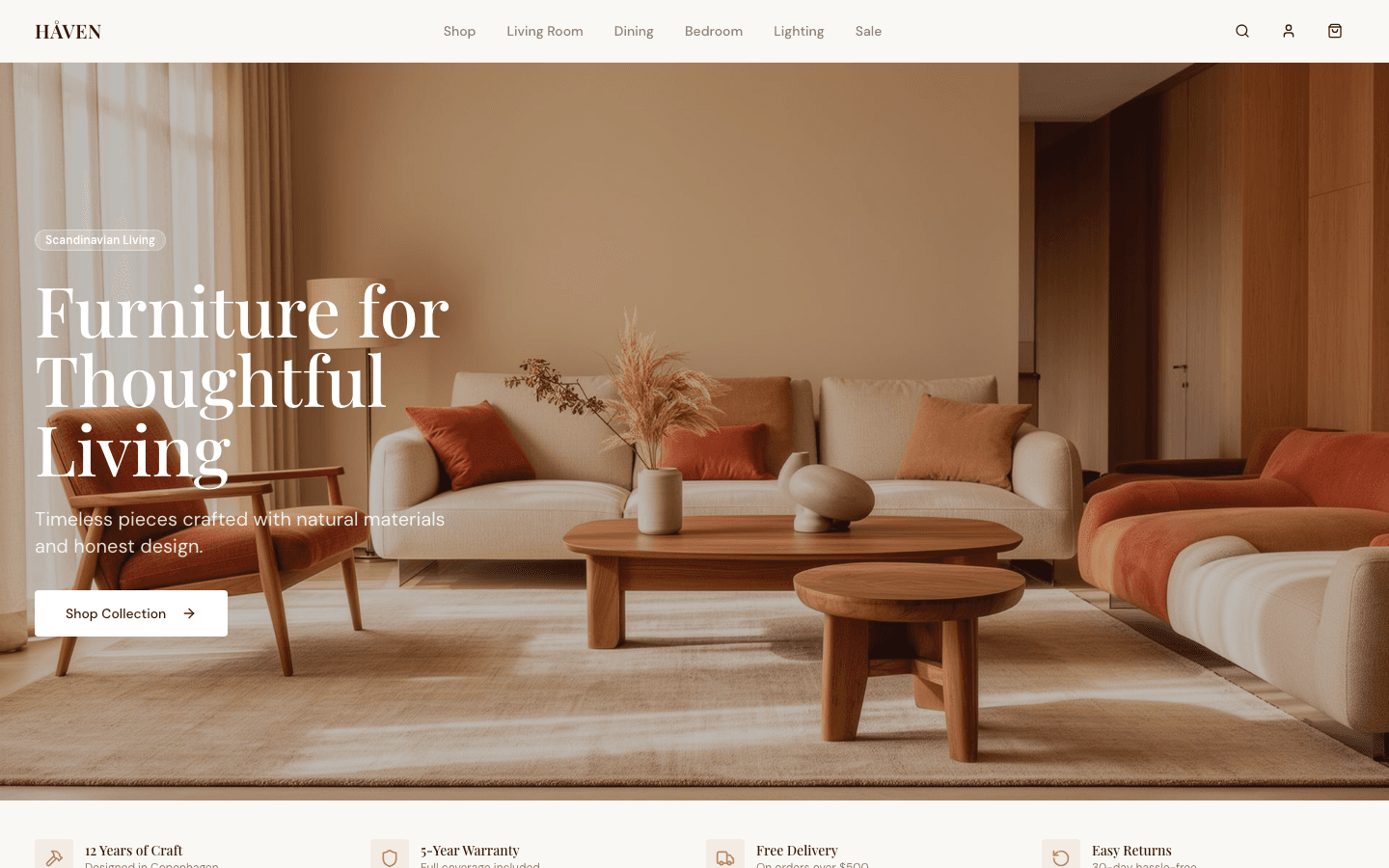
Photo by Clay Banks on Unsplash
How to Build an eCommerce MVP: Features You Actually Need
How to Build an eCommerce MVP: Features You Actually Need
Building an eCommerce MVP is deceptively complex. You think "I just need a product page and a checkout" — and then you discover you also need inventory management, shipping calculations, tax handling, order fulfillment, email notifications, returns, and a dozen other things.
The trick is knowing which features are truly essential for your first sale and which can wait until you've validated the concept.
The Minimum eCommerce Feature Set
Must-Have for Launch
Product Catalog
- Product listing page with images, title, and price
- Product detail page with description and add-to-cart
- Category or collection pages
- Basic search or filtering (by category at minimum)
Shopping Cart
- Add/remove items
- Update quantities
- Cart total calculation
- Persistent cart (survives page refresh)
Checkout and Payments
- Guest checkout (don't force account creation)
- Shipping address collection
- Stripe payment processing
- Order confirmation page
- Order confirmation email
Order Management (Admin)
- View all orders
- Update order status (processing, shipped, delivered)
- Basic order details (items, amounts, customer info)
Essential Pages
- Homepage with featured products
- About page
- Contact page or form
- Privacy policy and terms of service
- Shipping and returns policy
Defer to v2
| Feature | Why It Can Wait |
|---|---|
| User accounts and order history | Guest checkout is faster to implement and converts better for new stores |
| Wishlist / favorites | Nice to have, not essential for first sale |
| Product reviews and ratings | You need sales before you need reviews |
| Discount codes and promotions | Apply discounts manually via Stripe initially |
| Advanced filtering and sorting | Basic category pages are enough |
| Inventory tracking | Manual tracking is fine for <100 SKUs |
| Multi-variant products (size/color) | Start with simple products |
| Related products / recommendations | Add when you have enough products and data |
| Live chat | A contact form is sufficient |
| Abandoned cart emails | Optimize conversion after you have traffic |
eCommerce Tech Stack
| Layer | Recommendation | Alternative |
|---|---|---|
| Framework | Next.js | Remix, Nuxt |
| Payments | Stripe Checkout | Stripe Elements for custom UI |
| Database | PostgreSQL + Prisma | Supabase |
| Images | Cloudinary or Uploadthing | Vercel Image Optimization |
| Resend | SendGrid | |
| Hosting | Vercel | Railway, Netlify |
| CMS (optional) | Sanity, Contentful, or MDX | Database-driven admin |
Shipping for MVPs
Shipping is where most eCommerce MVPs get bogged down. Keep it simple:
MVP Shipping Strategy
| Approach | Complexity | Best For |
|---|---|---|
| Flat-rate shipping | Lowest | One product type, one country |
| Free shipping (baked into price) | Lowest | Higher-margin products |
| Weight-based tiers | Low | Multiple product sizes |
| Real-time carrier rates | High | Skip for MVP |
Recommendation: Start with flat-rate shipping or free shipping. You can integrate real-time carrier rates (UPS, FedEx, USPS APIs) after you understand your shipping patterns.
Tax Handling
| Approach | Complexity | Best For |
|---|---|---|
| Stripe Tax | Low | Automatic tax calculation at checkout |
| TaxJar | Medium | US sales tax compliance |
| Manual calculation | Low | Single-state businesses |
| No tax (include in price) | Lowest | Early validation, some jurisdictions |
Recommendation: Use Stripe Tax. It handles calculation automatically during checkout with minimal setup.
The 5-Week eCommerce MVP Timeline
| Week | Focus | Deliverable |
|---|---|---|
| Week 1 | Setup + product catalog | Boilerplate running, products displaying, category pages |
| Week 2 | Cart + checkout | Add-to-cart, cart page, Stripe checkout, order confirmation |
| Week 3 | Admin + orders | Admin panel for products and orders, order status management |
| Week 4 | Email + polish | Order emails, shipping policy, responsive design, SEO basics |
| Week 5 | Test + launch | Testing, production setup, launch |
eCommerce Metrics to Track
| Metric | What It Tells You | Target |
|---|---|---|
| Conversion rate | Visitors who buy | 1-3% is typical for new stores |
| Average order value (AOV) | Revenue per transaction | Depends on product |
| Cart abandonment rate | % who add to cart but don't buy | <70% is good |
| Customer acquisition cost (CAC) | Cost to get one customer | Should be < AOV |
Final Thoughts
An eCommerce MVP doesn't need to compete with Amazon. It needs to answer one question: will people buy this product online? A product page, a checkout, and flat-rate shipping are enough to validate that.
Build the simplest store that can make a sale. Then let real customer behavior guide your feature roadmap.
Need a complete checklist? Read eCommerce App MVP Checklist.
Considering Shopify? See Shopify vs Custom eCommerce MVP.
Want a template? Browse eCommerce templates on MVPHub.