Triage – Bug & Feature Tracker
About this MVP
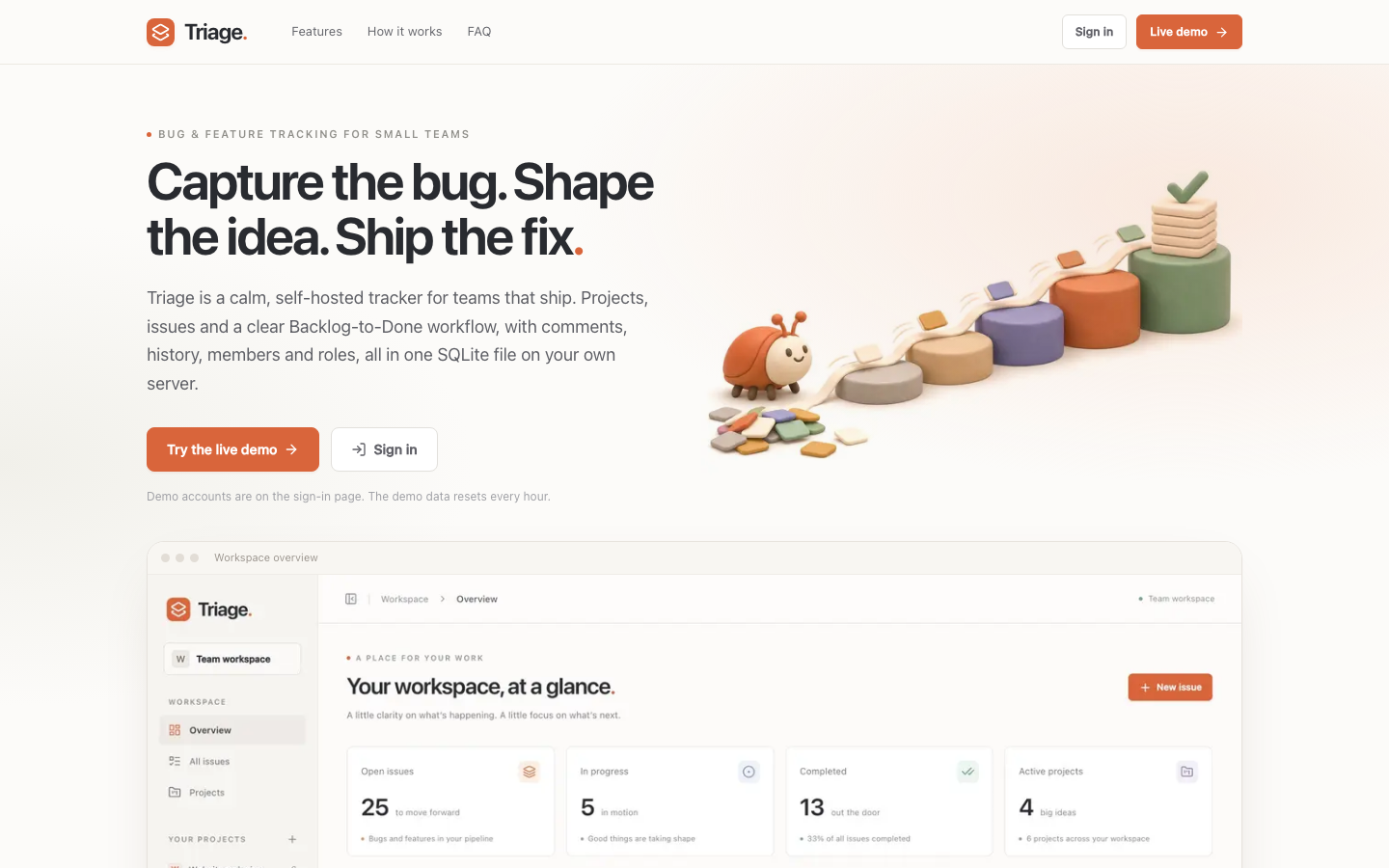
A self-hosted bug and feature tracker for small teams, built with Next.js 16 and SQLite: projects, issues with a Backlog-to-Done workflow, comments and a full activity history, email and password sign-in with members and roles, and a ready-made landing page. One app and one database file, with no external services to connect.
Runs with pnpm install and pnpm dev on Node.js 22.13 or later. It creates its SQLite database on the first request and opens a one-time setup page for the first admin. Ships with a Dockerfile, a health endpoint, 37 tests (including a check that every Server Action requires sign-in) and a demo mode that resets itself every hour.
Tech stack
Features
What's included
Details, reviews & discussion
Fit and launch readiness
Review the product stage, ownership terms and launch evidence before choosing your build.
- Type
- Launch-ready MVP
- MVP level
- Launch-ready
- Ownership
- Non-exclusive license
Who it's for
Small software teams, agencies and indie developers who want their own bug tracker without a per-seat subscription, and builders who want a clean Next.js and SQLite codebase with sign-in to start an internal tool or SaaS from.
Problem solved
Hosted trackers charge per seat and keep your data on their servers; spreadsheets lose the history of who changed what. Triage gives a small team projects, prioritised bugs and feature requests, a clear status workflow and a complete activity record, on a server you control, with nothing to sign up for.
Readiness evidence
Runs with pnpm install and pnpm dev on Node.js 22.13 or later. It creates its SQLite database on the first request and opens a one-time setup page for the first admin. Ships with a Dockerfile, a health endpoint, 37 tests (including a check that every Server Action requires sign-in) and a demo mode that resets itself every hour.
What you get
Triage is a calm, self-hosted bug and feature tracker for small teams. It is one Next.js app with the SQLite database built into Node.js: no database server, ORM, auth service or third-party account.
- Projects with a name, a short key (
WEB), description, colour and status (Active, Paused, Completed), progress bars, and per-project issue numbers (WEB-1,WEB-2) that are never reused - Bugs and features with title, description, priority (Urgent, High, Medium, Low) and assignee, with member names suggested
- A Backlog → Todo → In progress → In review → Done workflow, plus Canceled, with reopening
- All issues and per-project lists with Bugs/Features tabs, status and priority filters, four sort orders and search across titles, descriptions, keys and assignees; filters live in the URL so views can be shared
- Issue pages with a discussion thread and an activity history that records who changed what
- Sign-in with email and password, a one-time setup page for the first admin, a Members page for admins (add members with an initial password, change roles, remove members) and a Your account page (name and password)
- A public landing page with illustrations made for Triage, real screenshots, an FAQ and calls to action; turn it off with one setting
- A demo mode with one-click demo accounts that wipes and reseeds itself every hour
- A responsive layout: the sidebar becomes a top bar on phones
See it running
The live demo runs the product in demo mode. Sign in with one click as the admin or the member (admin@example.com or member@example.com, password triage-demo). Anything you change is reset within the hour.
Sign-in and security
- Passwords are hashed with scrypt and a random salt per user; unknown emails and wrong passwords get the same message and take the same time.
- Sessions are random tokens in an httpOnly, SameSite=Lax cookie (Secure in production); the database stores only a SHA-256 hash of each token.
- Every protected page and every Server Action checks the session first, and a test fails the build if one doesn't.
- Admins manage members and can delete projects; members do everything else. You can't remove yourself or the last admin.
- Sign-in attempts are throttled, and post-sign-in redirects only go to pages on the same site.
Built with
Next.js 16 (App Router, Server Components, Server Actions), React 19, TypeScript and Node.js's built-in node:sqlite (WAL mode, foreign keys, parameterised SQL). Plain CSS with design tokens, Lucide icons, Node's built-in test runner and a production Dockerfile.
Customise it
- Rename the product, colours and copy from one place each: design tokens in
app/globals.css, landing copy incomponents/landing. - Start empty for your own team, or with the sample workspace (
SEED_DEMO_DATA=true). - Keep or drop the landing page (
LANDING_PAGE=falsesends/straight to sign-in). - Deploy with Docker on any server with a persistent volume for the database; SETUP.md covers HTTPS, backups and rebranding.
What it doesn't do
Triage sends no email: admins create members with an initial password. If the only admin forgets their password, SETUP.md shows how to clear the accounts from the command line and create a new admin; projects and issues are kept. There are no file attachments, integrations (GitHub, Slack) or real-time updates, and it hosts one workspace per install.
Images
The landing page illustrations were made for Triage with OpenAI image generation and may be used with the product. The app screens are real screenshots.