AI Generated MVPs
Explore cutting-edge MVPs powered by artificial intelligence and machine learning. Discover innovative AI-driven solutions, smart applications, and automated tools that are shaping the future of technology.
Showing 20 of 20 AI-generated MVPs

Groover Multi-Purpose Store
A fully-polished, multi-purpose e-commerce template engineered for brands that need the full feature set on day one — not a minimal starter you outgrow in a month. Groover ships with a live Medusa-backed catalog, category + collection merchandising, search with multi-facet filtering (category, collection, price, sale, stock, sort), product-detail with variant selection + image gallery + stock messaging + related products, Stripe Elements checkout with provider-aware setup panels, account dashboard with guest order lookup and authenticated order history, customer auth with login/register/logout/profile edit, wishlist with guest browser persistence and signed-in customer sync, blog list + detail, store directory, track-order page, branded 404, About/Contact/FAQ/Terms legal shell, GTM-friendly dataLayer wired into PDP/cards/wishlist/cart/checkout/search, locale + RTL foundation with persistent language switcher, PWA installability baseline, theme switching that applies before hydration and persists in both local storage and cookies, header active-route navigation with live mini-cart summary, skip-link / focus accessibility basics, app-level and route-level loading fallbacks, a recoverable error boundary, generated robots.txt and sitemap.xml, shared SEO metadata helpers, and a Playwright / Vitest / Lighthouse test harness. Every copy string lives in a typed content map so rebranding is a find-and-replace pass, not a code rewrite. Deploy it as-is or use it as the most complete starting point you can buy for a serious storefront.
by Sam G
Furniture Store
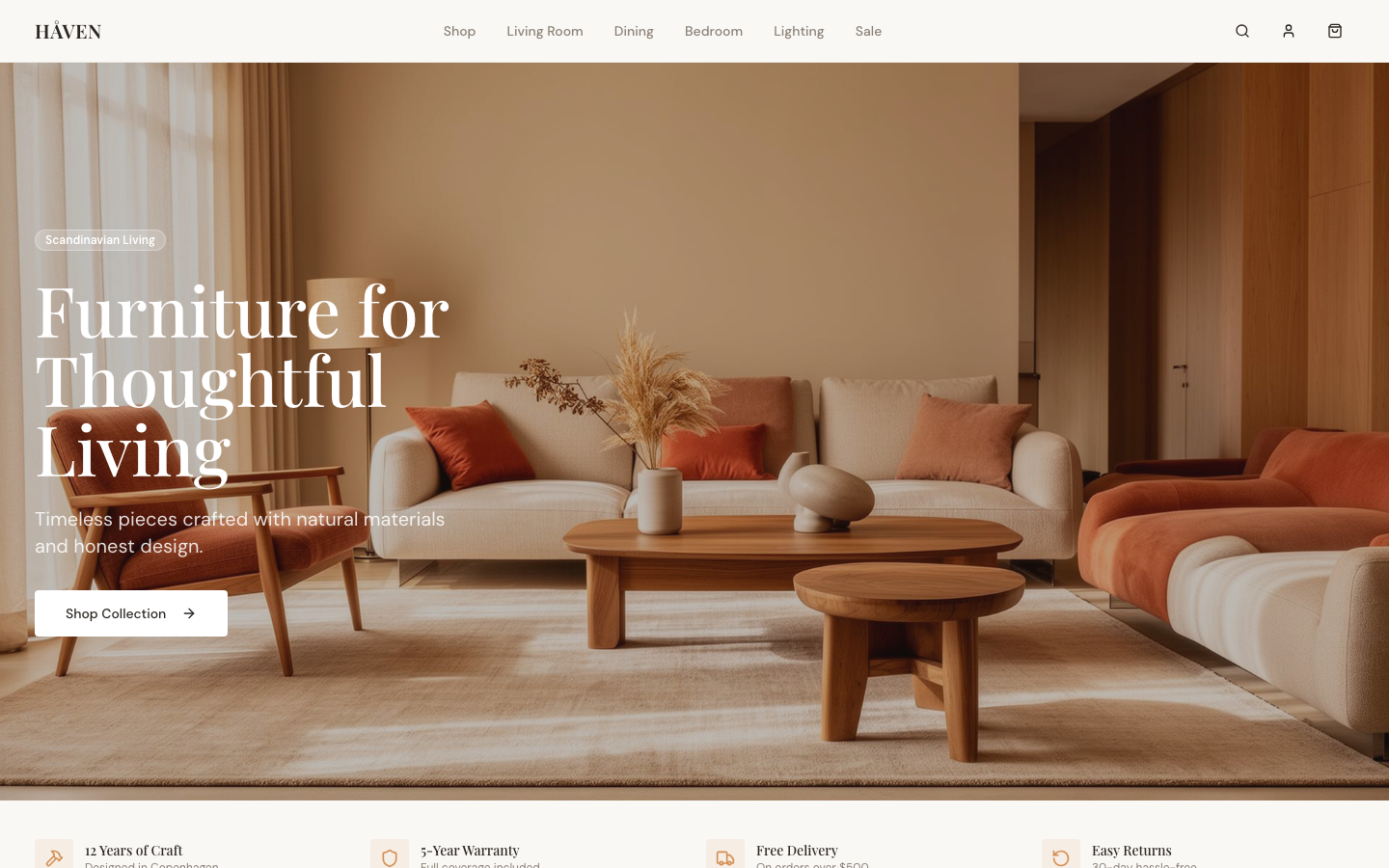
An elegant furniture and home furnishing e-commerce app with a design-forward Next.js storefront for SEO-optimized product pages and server-rendered category browsing. Alternative framework and mobile ports are available on demand. The visual design emphasizes large product imagery, room-based browsing, and material/color variant selection. Built with Radix UI, shadcn/ui, Tailwind CSS, and Framer Motion for a premium feel. Connects to any headless commerce backend — Medusa JS SDK integration is included. Form handling via React Hook Form with Zod validation ensures robust checkout and account flows. Great for furniture brands, interior design shops, or home decor marketplaces.
by Karl Brandt

Perfume Store
A luxury-styled perfume and fragrance e-commerce app built for premium brand presentation. The ready-to-buy Next.js storefront features rich product pages with scent profiles, bottle size variants, gift set options, and server-rendered collections. Mobile, backend, and alternative framework ports are available on demand. The design uses shadcn/ui and Tailwind CSS with an elegant, minimalist aesthetic suited for luxury goods. Easy to customize — swap product data, update branding, and deploy. Perfect for perfume brands, fragrance boutiques, or niche scent marketplaces.
by Marta Voss
Plant Pot Store
A stylish Next.js e-commerce app specializing in plant pots, planters, and plant stands, with server-rendered product pages for SEO. Alternative framework and mobile ports are available on demand. Features size and color variant selection, material-based filtering (ceramic, terracotta, concrete, wood), and curated collections. The UI uses shadcn/ui and Tailwind CSS with Framer Motion animations for smooth product transitions. Connects to any headless commerce backend — Medusa JS SDK is integrated in the storefront. Easy to maintain and extend — the component architecture is modular, and the API layer is abstracted for quick backend swaps. Perfect for home decor brands, plant accessory shops, or artisan pottery stores.
by Karl Brandt
Beauty Products Store
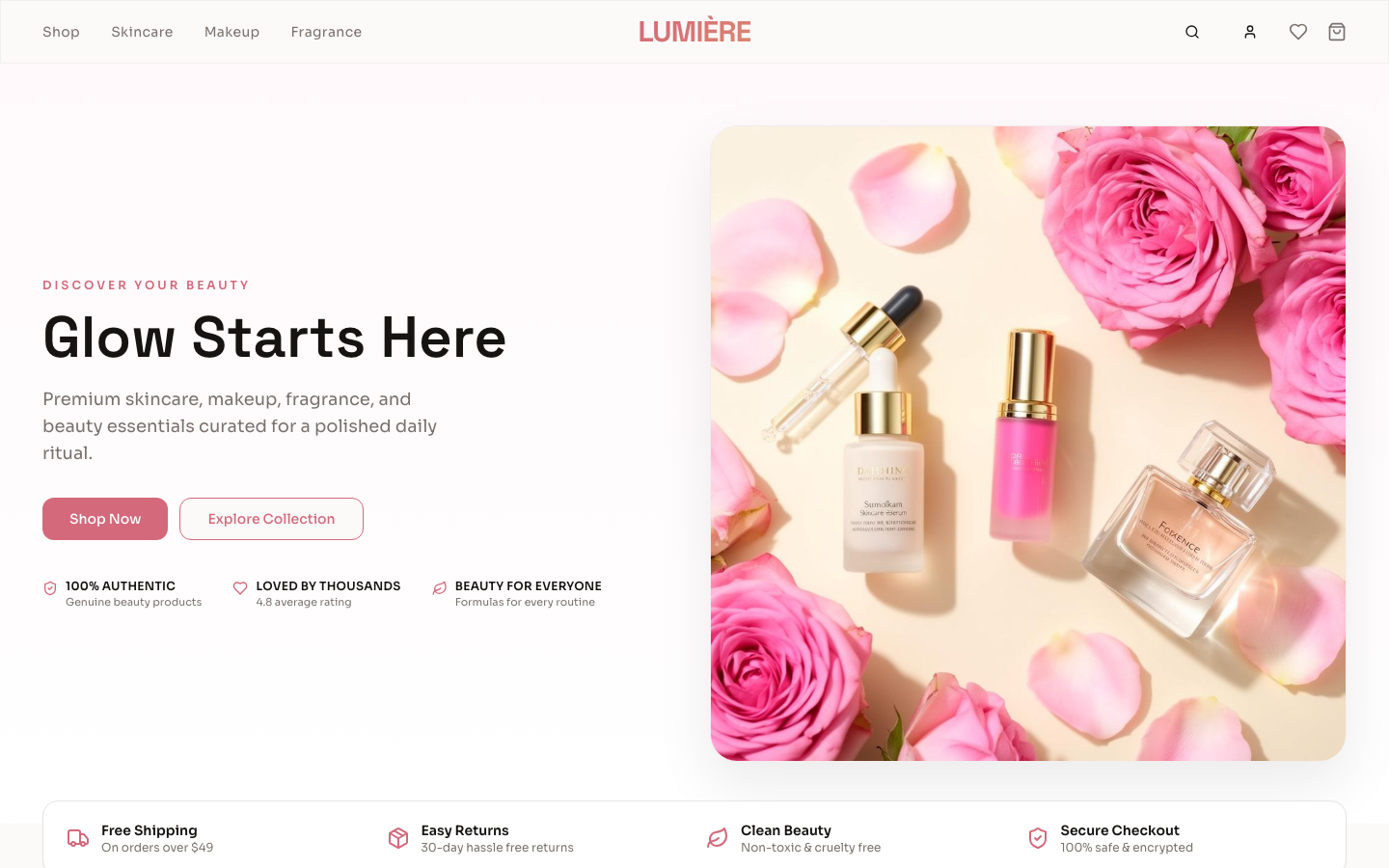
A modern, full-featured beauty and cosmetics e-commerce application built around a server-rendered Next.js storefront with SEO optimization. Alternative framework and mobile ports are available on demand. Connects seamlessly to a headless e-commerce backend such as Medusa, Shopify, or a custom API. Features product browsing with category filters, search, cart management, Stripe checkout, user authentication, and order tracking. The UI is built with Radix UI and shadcn/ui components styled with Tailwind CSS for a polished, accessible experience. Easy to set up — clone, install dependencies, configure your backend URL, and you are live. Ideal for launching a beauty brand, skincare line, or cosmetics marketplace.
by Marta Voss
Christmas Gift Store
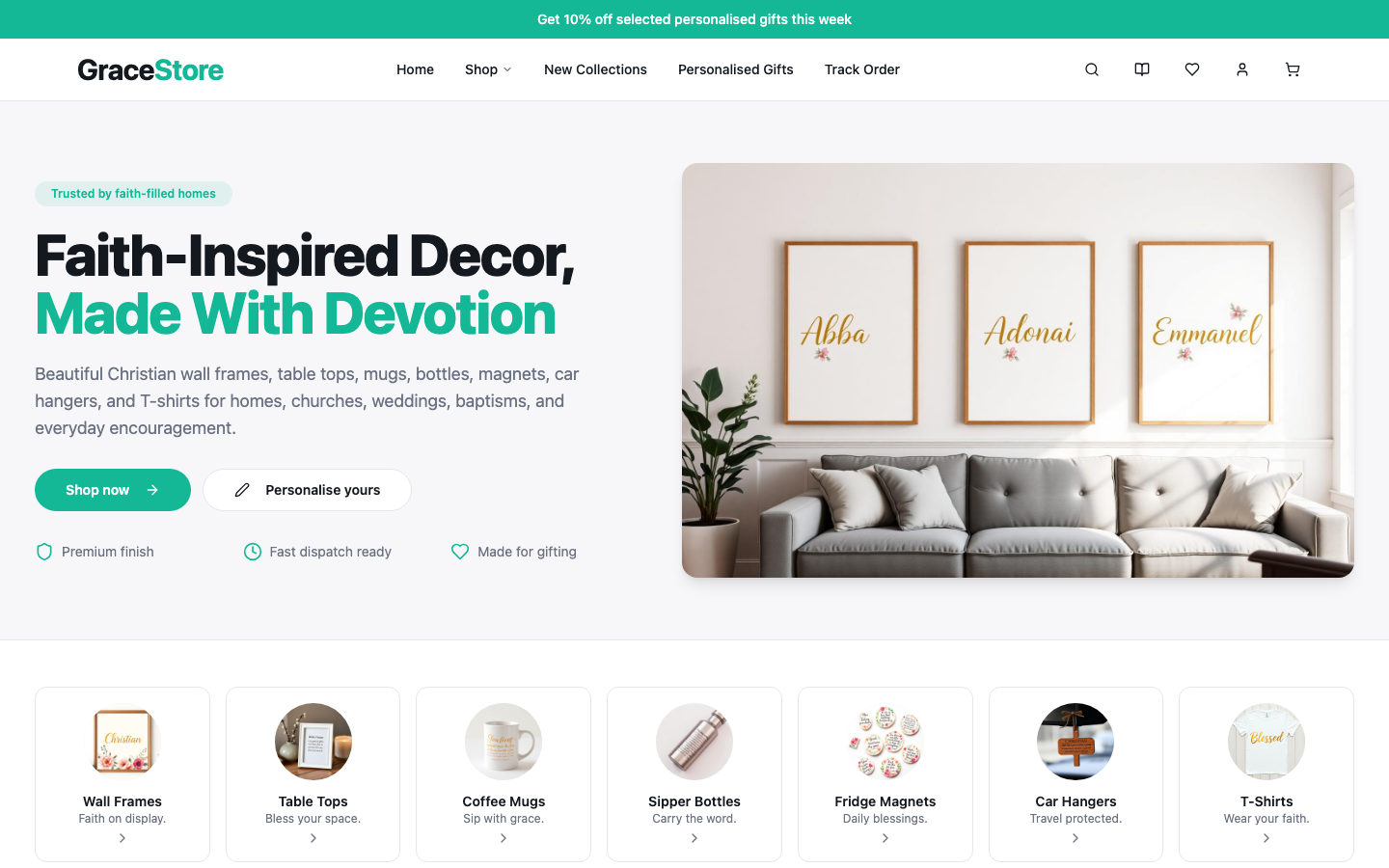
A festive, holiday-themed e-commerce application for selling Christmas gifts, decorations, and seasonal products. The ready-to-buy Next.js storefront provides server-rendered pages and full SEO support; mobile, backend, and alternative framework ports are available on demand. The storefront uses shadcn/ui and Tailwind CSS for a beautiful, responsive UI with holiday-ready theming, and connects to Medusa or another headless commerce API. Perfect for seasonal pop-up stores, gift shops, or holiday marketplaces that need to launch fast and look professional.
by Sam G
Kids Store
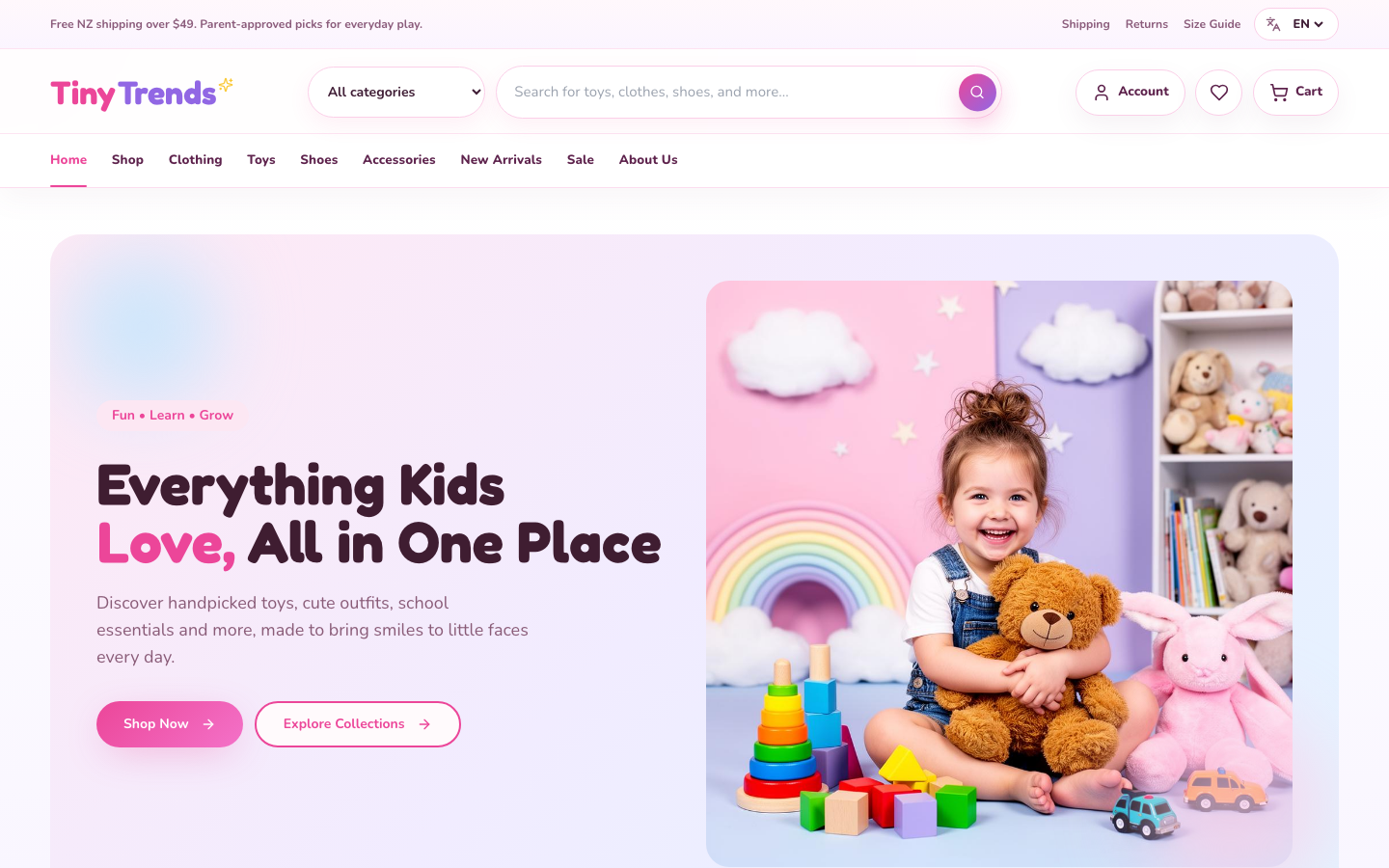
A playful, colorful e-commerce application for kids toys, clothing, books, and educational products. The ready-to-buy Next.js storefront provides SEO-friendly pages and fast loads; alternative framework and mobile ports are available on demand. The UI is built with shadcn/ui components and Tailwind CSS with a family-friendly design language. Supports age-group filtering, size/color variants, and category-based browsing (Toys, Clothing, Books, Educational, Baby Gear). Integrates with Medusa or any headless backend via a configurable API layer. TanStack Query handles data fetching and caching for a snappy browsing experience. Ideal for kids brands, toy stores, or baby product marketplaces.
by Sam G
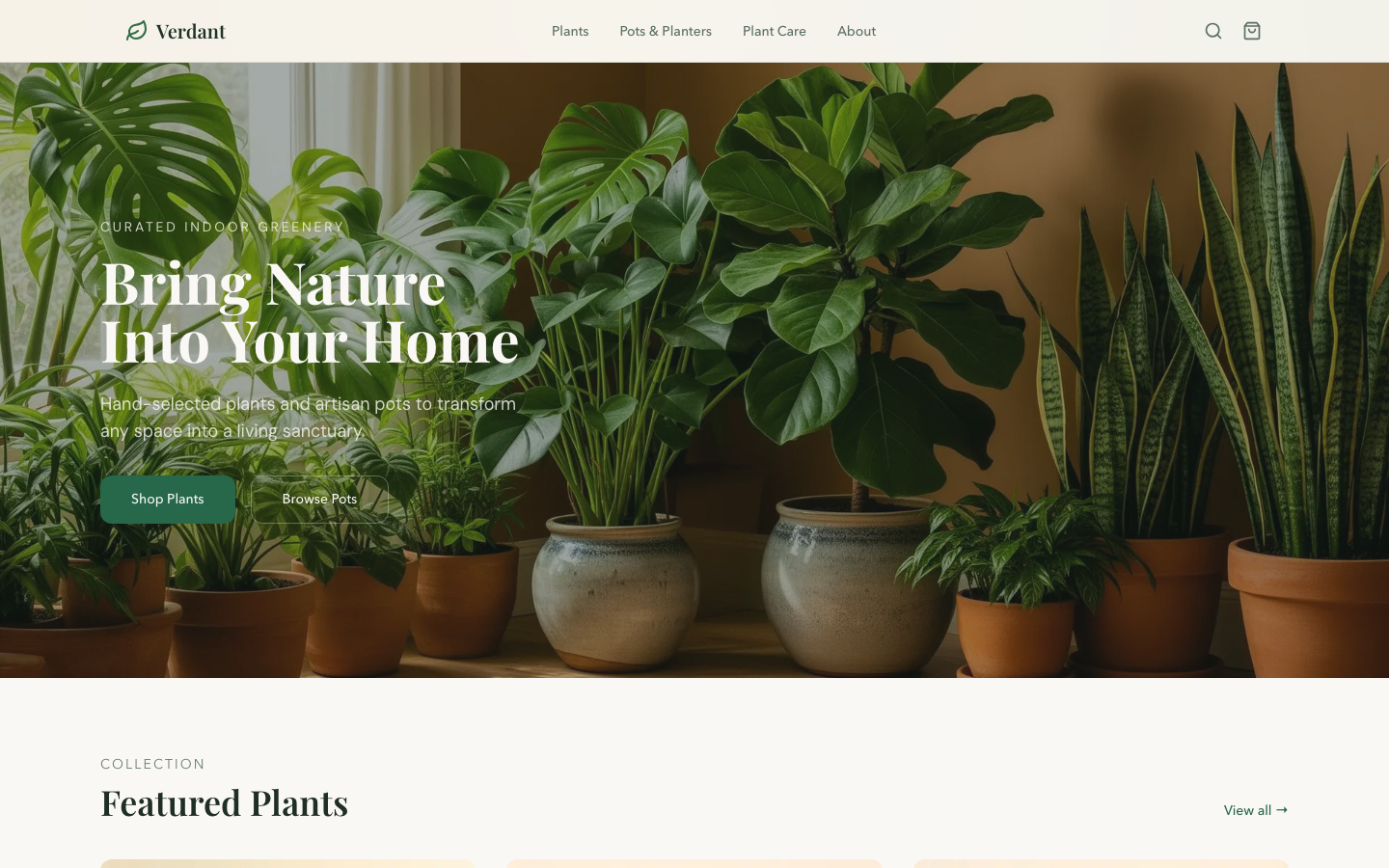
Plant Store
A nature-inspired Next.js e-commerce application for indoor and outdoor plants, succulents, herbs, and plant care products. Alternative framework and commerce-platform ports are available on demand. Supports botanical product browsing with categories like Indoor Plants, Succulents, Tropical, Herbs, and Plant Care. Built with Radix UI, shadcn/ui, and Tailwind CSS for a clean, earthy aesthetic. TanStack Query manages server state with smart caching for fast category switching. The headless design connects to Medusa, Shopify, or any REST API. Includes React Hook Form with Zod validation for checkout flows. Great for plant nurseries, garden centers, or online botanical shops.
by Kira Tanaka

Plumbing Store
A professional-grade Next.js e-commerce application for plumbing supplies, fixtures, and tools, with server-side rendering for product SEO and technical spec pages. Alternative framework and mobile ports are available on demand. Features finish/size variant selection (Chrome, Brushed Nickel, PVC sizes), technical specifications display, and bulk ordering support. Built with Radix UI, shadcn/ui, and Tailwind CSS for a clean, utilitarian design. Connects to any headless commerce API — Medusa integration included. TanStack Query handles product catalog caching for responsive filtering. Ideal for plumbing supply stores, hardware shops, or B2B fixture distributors.
by Sam G
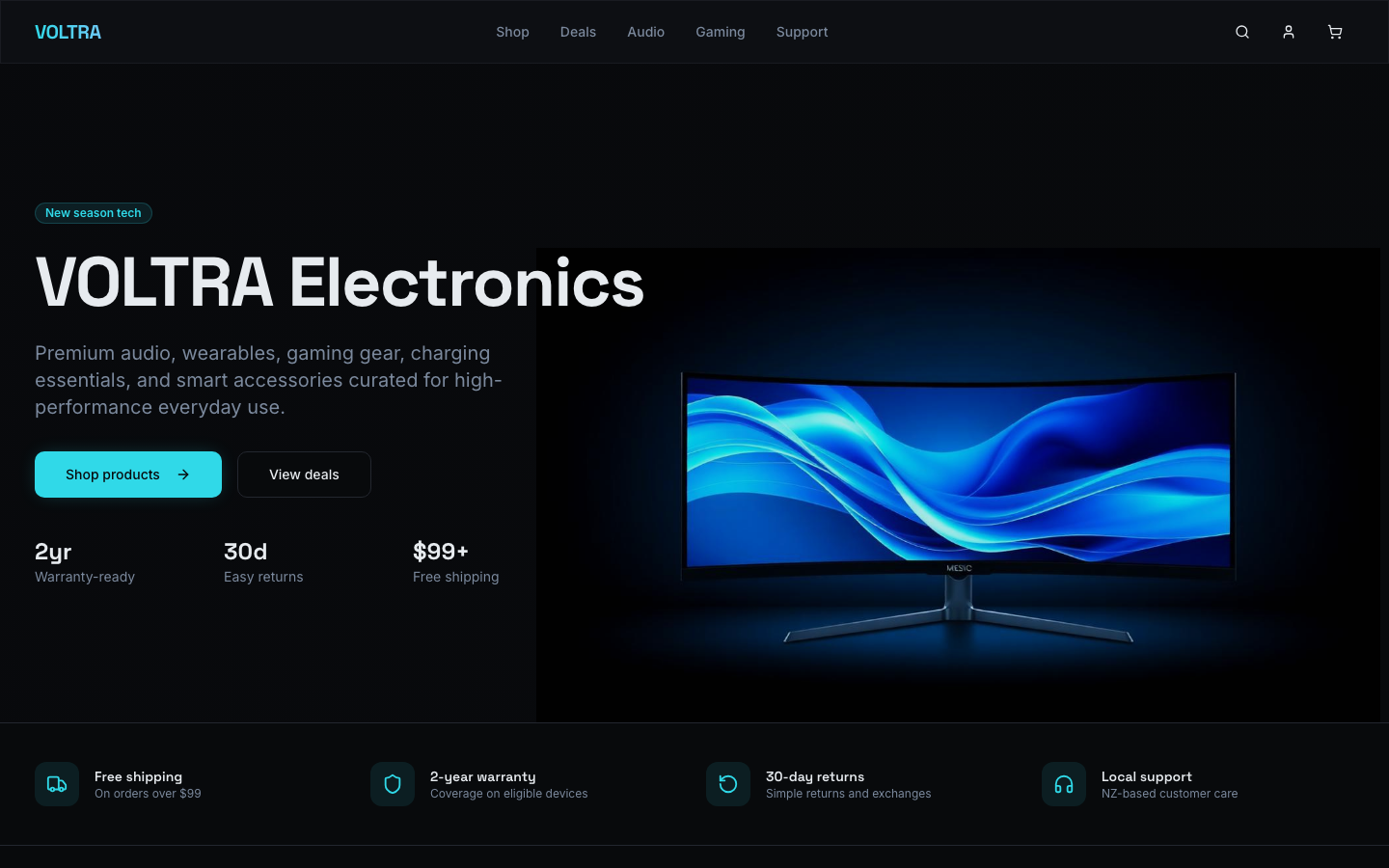
Electronics Store
A high-performance electronics and gadgets e-commerce application built around a Next.js storefront with server-side rendering for SEO and social sharing. Alternative framework and mobile ports are available on demand. Features advanced product filtering, variant selection (storage, color), comparison views, and Stripe-powered checkout. The component library is built on Radix UI and shadcn/ui with Tailwind CSS, providing a clean, modern interface suitable for consumer electronics. Backend-agnostic — works with Medusa, Saleor, or any REST/GraphQL commerce API. Quick setup with environment-based configuration and zero lock-in.
by Kira Tanaka
SM-Post Social Media Scheduler
SM-Post is a multi-tenant social-media posting and scheduling platform — the self-hostable core of a Buffer/Hootsuite-style product, delivered as a pnpm + Turborepo monorepo. Four apps: a Next.js 15 (App Router) + React 19 web client, a Fastify 5 API, a BullMQ worker, and a Playwright E2E suite; seven packages including a Prisma 6 data layer (33 models, 14 hand-authored migrations), a provider SDK, and an AES-256-GCM token vault. It runs on Postgres 17, Redis 7 and S3/MinIO. Nine real providers ship in the box — Bluesky, Mastodon and Telegram work out of the box, while LinkedIn, Facebook, Instagram, X, Pinterest and TikTok activate as soon as you supply your own platform-app credentials — plus a MockProvider whose content markers drive every branch of the publish state machine in tests and demos. The publishing engine is the differentiator: Postgres is the source of truth and BullMQ jobs are disposable, deterministically-named triggers, so you can flush Redis entirely and rebuild all queue state with one command. BullMQ is pinned to a single attempt and the application owns retry policy in the database (attemptCount / maxAttempts / nextRetryAt), because letting the queue retry would double-post; a maybe-sent outcome is never auto-retried and instead lands in an operator needs-review inbox, and a recorded success is never re-posted. Multi-tenancy is workspaces and projects with OWNER/ADMIN/MEMBER roles, hash-only email invitations, and an append-only audit stream. Per-project approvals bind an approval to a sha256 snapshot of the post content, media, per-provider overrides and targets — and the worker recomputes that hash immediately before fan-out, so an edited post can never ride an old approval. Stripe Checkout, the Billing Portal and a signed raw-body webhook back FREE/PRO/TEAM tiers with channel, post, member and project limits; omit the Stripe key and it drops into self-host mode with everything unlimited. Media uploads are presigned straight to S3/MinIO so bytes never transit the API, then content-sniffed with sharp on completion. Auth is passwordless magic-link (better-auth) with optional Google OIDC. Provider tokens live in an append-only encrypted vault — rows are inserted on refresh, never updated, and never stored on the channel row. Operationally it ships liveness and readiness probes, pino structured logs with secret redaction and request IDs, opt-in Sentry, Redis-backed rate limiting, Zod env schemas that fail fast at boot, and a production guard that refuses to start with dev secrets. Tests: 65 unit files, 19 integration suites against real Postgres/Redis/MinIO/Mailpit, and 5 Playwright journeys covering auth + tenancy, connect + publish, approvals, failure review, and billing limits. Ideal for founders launching a niche or vertical scheduling tool, agencies running client social calendars under one roof, teams that want first-party control of their social tokens instead of renting a SaaS seat, and developers who want a genuinely production-shaped queue, tenancy and OAuth codebase to learn from.
by Sam Houz
Hireloop Self-Hosted Job Board
Hireloop is a self-hostable, production-grade job board built on Next.js 15 (App Router), Postgres 16, and Drizzle ORM. Candidates browse, filter, and bookmark roles; employers create a free account, post a job, and manage their listings from any device; admins moderate the board. The auth layer uses bcryptjs work-factor-12 password hashes and opaque session tokens (raw bytes in an HttpOnly cookie, only sha256(token) stored server-side) with a 30-day sliding expiry. Email verification and password reset use atomic UPDATE ... RETURNING tokens so replay is impossible, with Resend in production and Mailpit/SMTP in dev/CI. Self-serve account deletion soft-deletes the user, scrubs PII, and closes every owned posting (GDPR-aligned). Every /api/auth/* and /api/me/* endpoint sits behind in-memory rate limits and is wrapped in a top-level handler that emits structured JSON logs (request id, route, method, ip, status, ms) and returns a sanitised 500 so Drizzle internals never leak through. Security headers (HSTS, CSP, X-Frame-Options: DENY, X-Content-Type-Options, Referrer-Policy, Permissions-Policy) are set in next.config.ts and apply to every route. /api/health and /api/ready expose liveness + readiness probes for any load balancer or orchestrator. Sentry integration is one env var (SENTRY_DSN) away; the SDK is dynamically imported so a deploy without it pays zero cost. Tests: 80 unit (Vitest), integration suite against an ephemeral Postgres (testcontainers), and Playwright E2E that round-trips the verify-email and password-reset flows through Mailpit in CI. SEO: per-listing schema.org JobPosting JSON-LD (Google for Jobs ready), canonical URLs, OG image, sitemap, robots disallow on every gated route, and a bundle-size budget enforced in CI. Ideal for indie founders launching a niche job board, agencies building white-label boards for clients, internal hiring portals at companies that want first-party data, and developers learning a modern Next.js + Postgres + auth-from-scratch stack.
by Sam Houz
Offer App NZ Offers & Cashback Platform
A full multi-application platform for New Zealand offers, coupons, cashback, merchant management, admin operations, and mobile discovery. The repo ships as a pnpm + Turborepo monorepo with a NestJS API backed by Prisma, PostgreSQL, and Redis; a consumer-facing Next.js web app; dedicated admin and merchant portals; an Expo React Native mobile app; and shared packages for typed API access and DTOs. It includes tracked redirects, coupon copy tracking, cashback activation, wallet and referral foundations, notifications, wishlist flows, sponsored listings, premium subscription surfaces, and merchant tooling. The mobile app uses Expo Router and TanStack Query, while the web experience uses Next.js 16 and shared typed API client packages. The platform is especially useful for founders building a regional rewards marketplace, affiliate coupon platform, or cashback network with separate consumer, merchant, and admin surfaces in one codebase.
by Sam Houz
InvoiceFlow Pro Dashboard
A clean invoicing and billing dashboard built as a React 19 + Vite single-page app with a premium finance-oriented UI. It includes a collapsible sidebar shell, dashboard stats, recent invoice table, invoice builder flow, client management placeholder, payment tracking view, and settings surface in one polished front-end package. The builder supports invoice metadata, line items, subtotal/tax/total calculations, notes, toasts, and a clear handoff path for future PDF export or API integration. The UI layer is built with Tailwind CSS, Radix UI, and shadcn/ui, with typography and token choices tuned for modern back-office dashboards. The app also ships with React Router, TanStack Query, React Hook Form, Zod, Vitest, and Playwright, making it a strong starting point for freelancers, agencies, internal finance tools, and startup billing dashboards that need a solid front-end foundation fast.
by Sam Houz
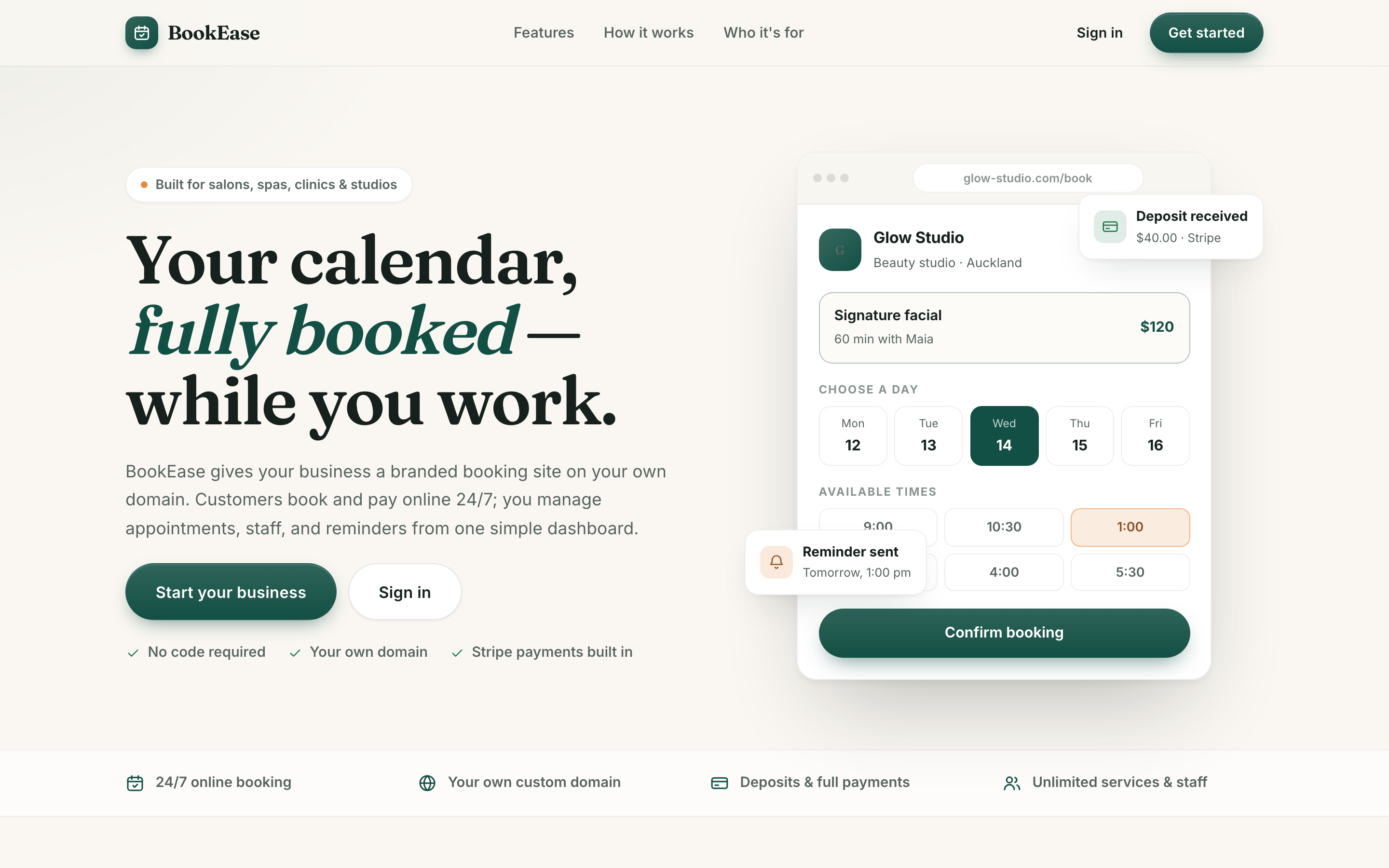
BookEase Multi-Tenant Booking Platform
A launch-ready multi-tenant salon and spa booking platform built as one shared Fastify backend plus one shared Next.js web app, with one tenant database per business. It includes a control-plane for platform users, tenant registry, memberships, domains, audits, and migrations, while each tenant database owns services, staff, schedules, blocked times, customers, appointments, booking settings, payments, reminders, and tenant audit logs. The frontend runs in platform mode and tenant mode from a single codebase, using a host-aware BFF layer so tenant identity is resolved from the request host rather than browser-visible tenant ids. Public booking flows support service selection, optional staff selection, live availability, Stripe checkout, booking status polling, runtime tenant theming, and tenant admin surfaces under /admin. The platform also ships with branding controls, custom domain verification, demo reset and verify commands, worker processes for reminders and hold expiry, and localtest.me based launch testing. Ideal for salon chains, spa groups, appointment-based wellness brands, or founders building a white-label multi-tenant scheduling SaaS.
by Sam Houz
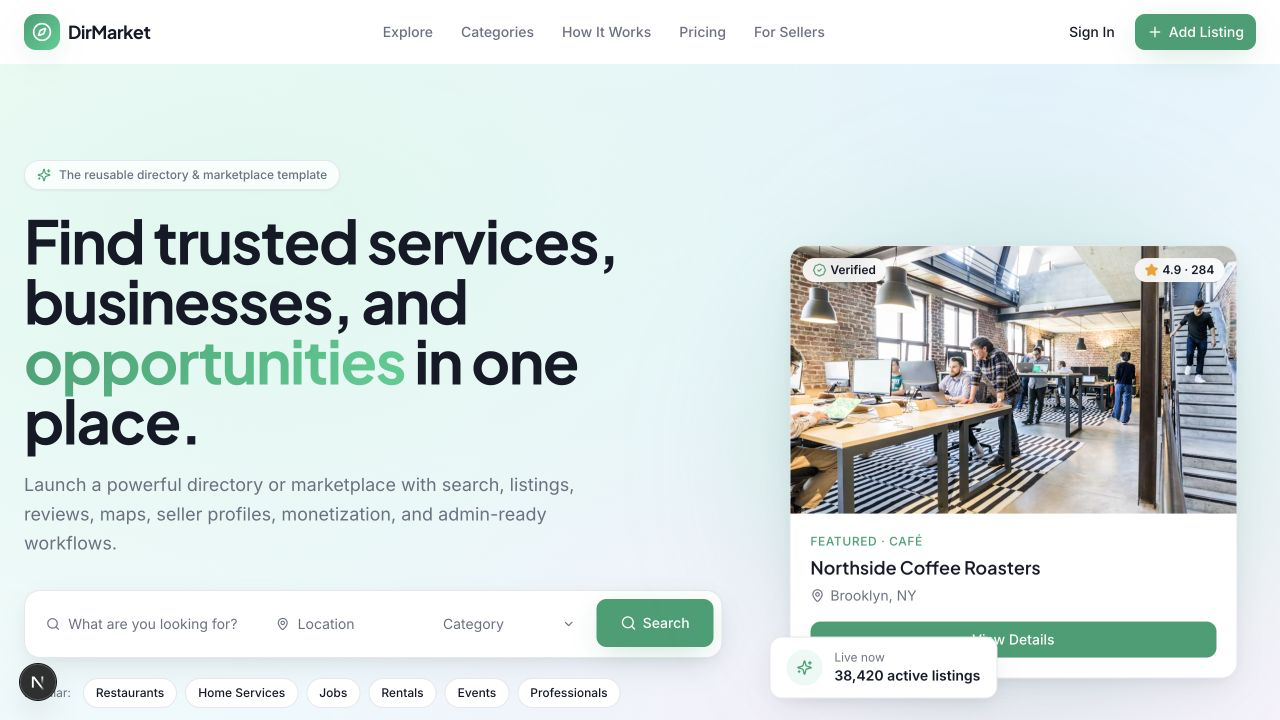
Traders Marketplace — Directory & Listings Platform
A production-oriented directory and listings marketplace built with Next.js 16, React 19, TypeScript, Tailwind CSS, Prisma, and PostgreSQL. It ships complete buyer, seller, and administrator journeys: category-led discovery, text and map search, listing detail pages, seller profiles, favourites, saved searches, enquiries, messaging, review moderation, listing management, onboarding, reporting, account privacy controls, audit logs, and installable PWA support. Authentication uses secure cookie sessions with refresh rotation, same-origin mutation protection, rate limiting, email verification, password recovery, and role-aware authorization. The database includes migrations and realistic seed data; Vitest and Playwright cover the core API and browser journeys. Docker targets separate migrations, workers, build, and runtime services, while the CI workflows run type, unit, browser, dependency, and security checks. Stripe billing, S3-compatible media storage, Mapbox maps, email delivery, and web push are integrated but require the buyer's own production credentials. Ideal for agencies, local-business networks, trade directories, service marketplaces, and founders launching a niche classifieds or discovery platform.
by Sam Houz
MVP ForSale Promo Storefront
MVP ForSale (mvp.forsale) is a server-rendered promotional listing storefront for an MVP Hub-style marketplace, built on Next.js 16 (App Router) and React 19 with plain JavaScript and zero UI-framework dependencies. It is a read-only catalog frontend: every page fetches the marketplace catalog server-side from MVP Hub's public API, so crawlers and link previews receive full HTML, and every buy action deep-links back to the marketplace with UTM attribution. SEO is the core feature set — per-listing metadata and Open Graph tags, schema.org Product JSON-LD with offer price and aggregate rating, canonical URLs, a live sitemap.xml generated from the catalog, robots.txt, and noindexed search results. The catalog UX covers category landing pages with data-derived subcategory chips, faceted search (category, tech stack, capability, price slider), client-side sort, listing detail pages with gallery, seller-provided markdown body (rendered with raw HTML stripped), readiness badges, verified-review counts, and multi-variant "from" price ranges. Data-integrity guards are built in: reviews are never fabricated, unpriced listings never show $0, demo buttons only render for real demo links, and sold-out or coming-soon sale statuses are respected. The visual theme is a distinctive hand-drawn wireframe aesthetic (Kalam handwriting font, sketch-style browser chrome) that is deliberately easy to re-skin: one CSS file, design tokens at the top. Easy to set up — clone, set three env vars (API origin, public marketplace origin, canonical site origin), pnpm install, pnpm dev; ships with a BuildKit-secret Dockerfile producing a Next.js standalone image with a liveness health route for blue/green deploys. Pluggable against any backend exposing the /api/mvps list + detail contract. Ideal for marketplace operators who want a second themed storefront or SEO promo surface for the same catalog, agencies white-labelling listing sites, and developers who want a clean reference for server-rendered catalog SEO on the App Router.
by Sam Houz

Contest.design Design Contest Marketplace
A design contest marketplace and in-house contest creation platform. Designers discover live and upcoming contests to win prizes and grow their portfolios, while brands and communities launch and manage their own competitions. Aggregates opportunities across logo, UI/UX, illustration, branding, and 3D design — from both platform-hosted contests and trusted external organizers — each with deadlines, prize details, and organizer context. Includes contest discovery with search and category filtering, a winners showcase, editorial articles, and a built-in "Submit Contest" flow so organizers can publish briefs, set prizes and deadlines, and manage submissions. Built as a modern Next.js App Router web platform with Tailwind CSS, Radix UI, and a Postgres backend.
by Sam Houz
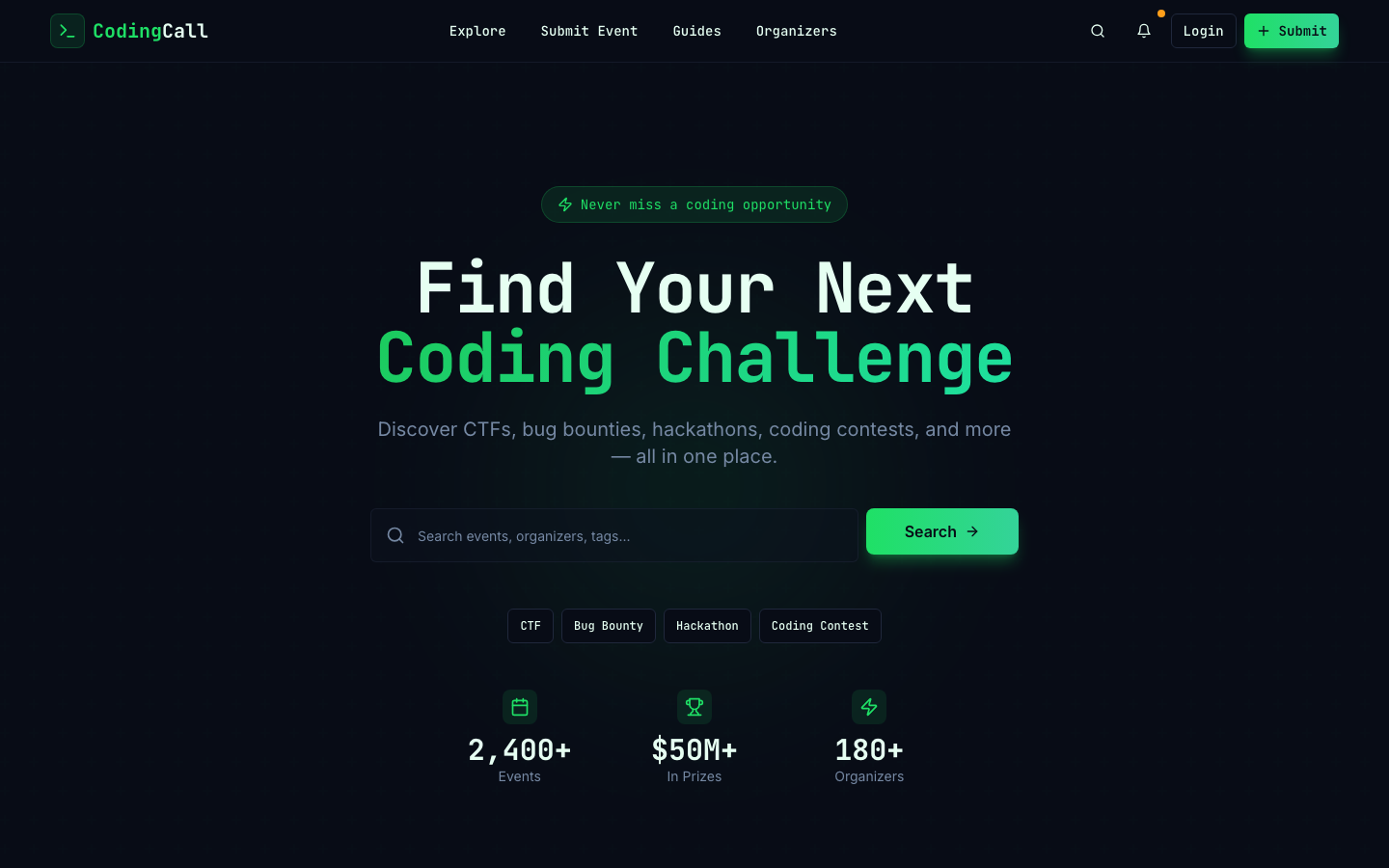
CodingCall Coding Event Marketplace
A coding event marketplace that aggregates CTFs, bug bounties, hackathons, and coding contests in one place so developers never miss a coding opportunity. Provides event discovery with search across events, organizers, and tags, category browsing (CTF, bug bounty, hackathon, coding contest), organizer profiles, guides, and a "Submit Event" flow for organizers to list and manage their competitions with prize pools and deadlines. Surfaces opportunities at scale across thousands of events and hundreds of organizers. Built as a modern Next.js App Router web platform with Tailwind CSS, Radix UI, and a Postgres backend.
by Sam Houz
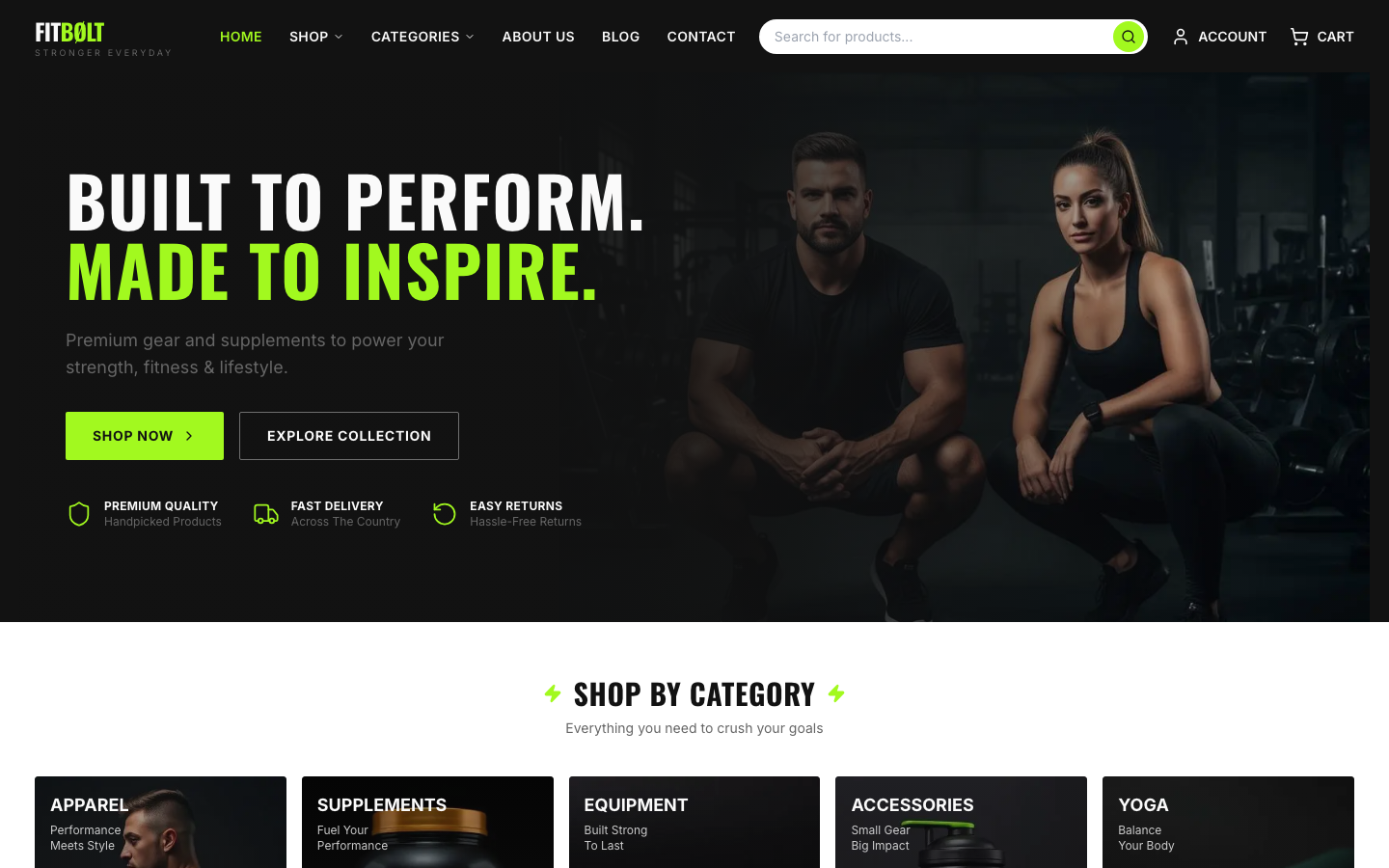
Fitness Store
A performance-driven fitness and sports e-commerce application for gear, supplements, apparel, and training accessories. The server-rendered Next.js storefront is ready to buy with SEO-ready product and category pages; a React Native mobile port is available on demand. Supports category browsing (Apparel, Supplements, Equipment, Accessories, Yoga), size/flavour/colour variants, search with filtering, cart, and Stripe checkout. Built with Radix UI, shadcn/ui, and Tailwind CSS for a bold, high-energy interface, and connects to any headless commerce backend — Medusa JS SDK integration included. Ideal for supplement brands, activewear labels, gym-equipment retailers, or multi-category fitness marketplaces.
by Sam G